

In the world of B2C apps, customer access is usually stuck in a binary "Allow or Deny" trap. But modern consumers want nuance: they want to protect their video streaming password while sharing access with a sibling; they want to give their kids a "digital allowance" in an online social game without handing over the keys to the kingdom; or they want family members to add milk to an online grocery cart without sharing a master login.
By failing to provide a personalized customer experience, businesses aren't just frustrating users, they are leaving revenue opportunities on the table.
Most developers struggle to deliver this flexibility because traditional authorization models like Role-Based Access Control (RBAC) are too rigid. Building a granular "Family Account" model from scratch typically requires months or years of development, constant auditing, and high effort on future-proofing.
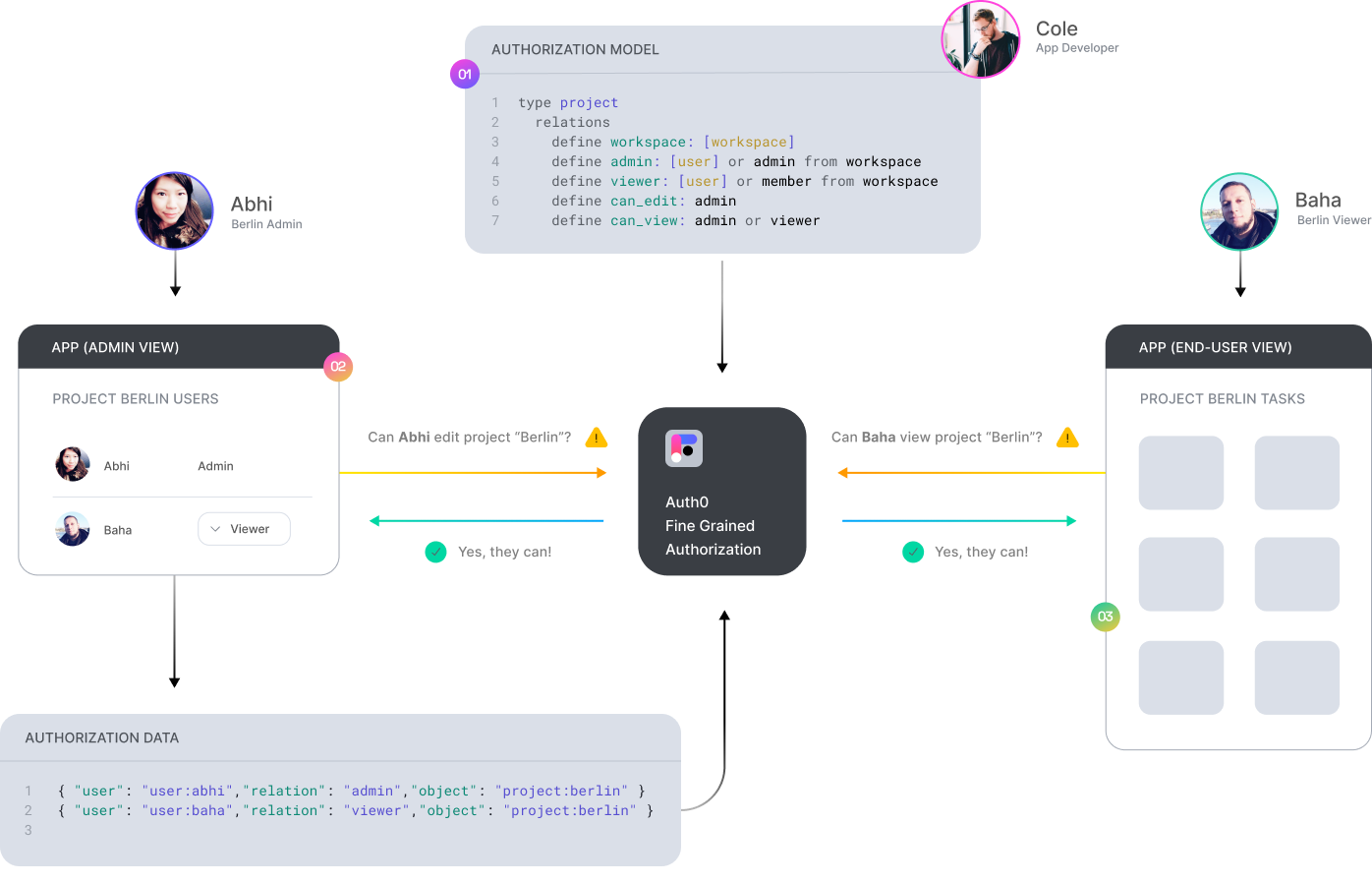
This is where Fine-Grained Authorization (FGA) changes the game. Based on Google’s Zanzibar white paper and Relationship-Based Access Control (ReBAC), FGA allows access rules to be based on relationships (for example, "This user is a child of this subscriber"), eliminating most of the complexity associated with traditional authorization models.
By enabling easy creation of fine-grained authorization models, FGA is more than just an efficient access control and a security checkbox. It can be the engine of various new revenue value drivers for B2C apps. In this blog post we’ll explore three of them.
1. Streaming and Media: Family Accounts
Streaming companies lose billions to password sharing. According to Bain & Company, on average 26% of streaming subscriptions are shared. Simply banning these users is also a high-risk move that leads to "churn" and brand damage. However, ignoring the issue means leaving untapped revenue on the table.
FGA enables a primary account holder to share their subscription with a sibling living in a different city. Instead of losing a user, you sell an "Add-on Seat" (for example, $2.99/month), converting a freeloading viewer into a predictable revenue stream.
An illustrative example of revenue uplift potential for a streaming business with 100K subscribers leveraging FGA is:
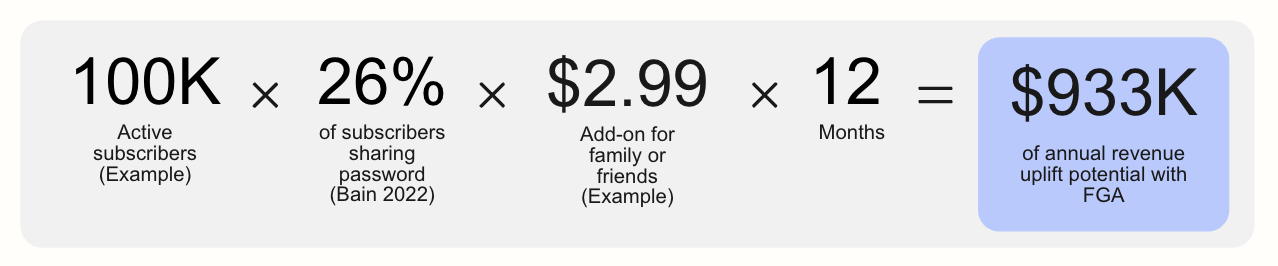
100K active subscribers x 26% of subscribers sharing passwords (Bain 2022) x $2.99 add-on for family or friends x 12 months = $933K of annual revenue uplift potential with FGA.
2. Gaming: Parental Wallet and Spending Limits
Gaming companies are moving from selling one-off titles to "Live Services" where ARPU (Average Revenue Per User) is driven by microtransactions.
Many parents want to let their children play online social games and buy “skins”, but they are terrified of a $500 surprise credit card bill. They don't want to enter the password every time, but they don't want to give full access.
By only allowing a binary Allow or Block in-game transactions, many parents opt for the safer option. According to the research firm IPSOS, in Europe, 76% of parents claim that their children do not spend on any in-game extras. Among the children who spend money in-game, their parents reported an average monthly expenditure of $34 (€31) in 2024.
FGA unlocks safe spending for minors. By removing the friction of the parent needing to be present for every purchase, while guaranteeing safety via enhanced parental dashboards with FGA, there’s an opportunity to convert a portion of that 76% "non-spending" demographic.
An illustrative example of revenue uplift potential for a children game with 100K users leveraging FGA is:
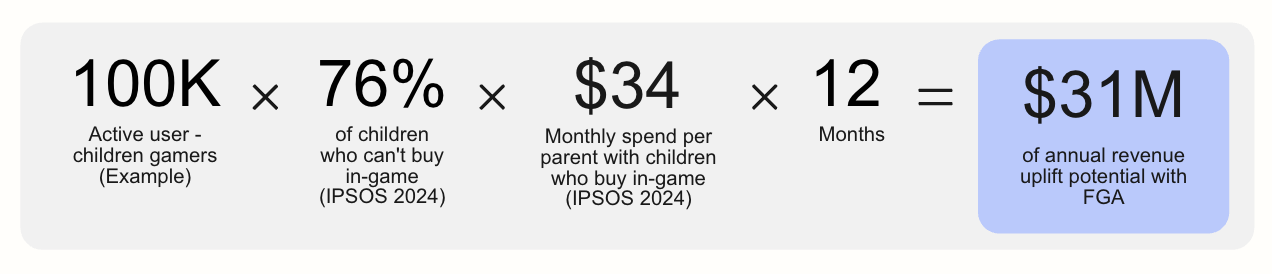
100K active users (children gamers) x 76% of children who can’t buy in-game (IPSOS 2024) x $34 of monthly spend per parent with children who buy in-game (IPSOS 2024) x 12 months = $31M of annual revenue uplift potential with FGA.
3. Grocery E-commerce: Shared Family Shopping Basket
Most grocery shopping apps are tied to one login. If a child or spouse wants to add an item, they have to share a password (a security risk) or text the primary account holder. This leads to forgotten items, fragmented shopping, smaller basket sizes and an overall loss in revenue. Research shows that 11% of parents freeze accounts to avoid unapproved overspending.
Research conducted by OnePoll for Slickdeals reveals that families spend 35% more when involving kids. FGA can capture this revenue opportunity and drive larger digital baskets by enabling Family Shopping Basket. A parent could allow a teenager to autonomously add items to the family shopping cart and check out the order, but only for specific categories like "Snacks" or "School Supplies” and with an order limit.
An Illustrative example of revenue uplift potential for an online grocery store allowing family shopping baskets, with FGA is:

100K active user accounts x 39% of households with child under 18 years (USA, Census 2024) x 11% of parents freeze accounts to avoid unapproved spending x $170 average digital grocery basket size (USA, Incisiv 2024) x 35% increase in expenditure when shopping with children (OnePoll 2023) x 6 digital grocery orders per year = $1.5M of annual revenue uplift potential with FGA.
Why Auth0 FGA?
Auth0 FGA provides a cloud-native, centralized, and API-driven approach to managing complex authorization requirements that is flexible and scalable. Okta's centralized view into authorization policies allows customers to manage their compliance goals efficiently. Authorization as a service eliminates authorization complexity across systems, users, and applications and delivers scalable and fully flexible authorization: customers can now use Okta to build team collaboration, multi-tenancy, custom roles, IoT, and cloud entitlement management.
In comparison, legacy identity vendors use traditional, role-based authorization methods that have limited granularity, are static, and are implemented at the application level.
Key features and benefits of Auth0 FGA
Centralized Authorization Management: Auth0 FGA allows organizations to manage all their authorization policies in a centralized location. This centralization simplifies the management of access control policies across multiple applications and services, reducing complexity and helping ensure consistency in policy enforcement across the organization.
Policy-Based Access Control: Auth0 FGA supports policy-based access control (PBAC), enabling the definition of complex access control policies using an expressive policy language. This approach allows for granular control over who can access what resources under what conditions, improving the security posture of applications.
Scalability and Performance: Auth0 FGA is designed to be highly scalable, leveraging cloud-native infrastructure to handle high volumes of authorization requests with low latency. This helps ensure that authorization checks are performant even in large-scale, distributed environments.
Flexibility and Extensibility: Auth0 FGA provides an extensible framework that can be customized to meet specific business needs. It supports various data models and relationships, making it suitable for a wide range of use cases. Flexibility in defining policies and relationships allows organizations to tailor the authorization system to their unique requirements.
Ease of Integration: Auth0 FGA integrates seamlessly with existing Okta identity and access management (IAM) solutions and other third-party services. Easy integration simplifies the adoption of fine-grained authorization and reduces the time and effort required to implement robust access control.
Authorization is not just a security checkbox, it is a revenue growth lever. With Auth0 FGA, it is possible to build the flexible, relationship-based experiences that B2C customers demand.