

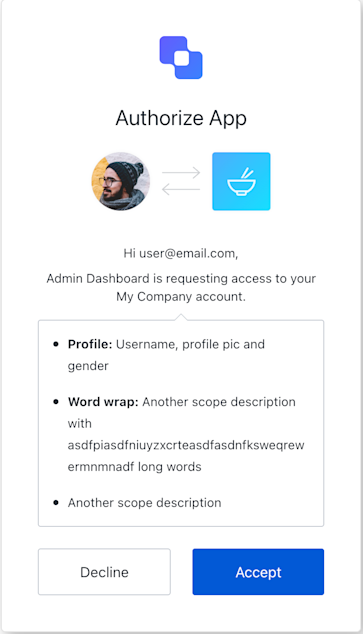
customized-consent screen functionality. This screen prompts the user to accept or deny the permissions and authorization details requested by a client application.
Constructors
Create an instance of CustomizedConsent screen manager:Example
Properties
Provides branding-related configurations, such as branding theme and settings.
Provides client-related configurations, such as
id, name, and logoUrl, for the customized-consent screen.Provides country code data for phone number entry, such as
available and recommended, for the customized-consent screen.The active Experiment Center experiment for this screen, or
null when no experiment is active (or the screen has not opted in via context_configuration).Provides information about the user’s Organization, such as
id and name.Contains data about the current prompt in the authentication flow.
Contains details specific to the
customized-consent screen, including scopes and authorizationDetails.Contains data related to the tenant, such as
id and associated metadata.Provides transaction-specific data for the
customized-consent screen, such as active identifiers and flow states.Handles untrusted data passed to the SDK, such as user input during the consent flow.
Details of the active user, including
username, email, and roles.Methods
Promise<void>
This method submits the user’s decision to accept the requested permissions and authorization details.
Example
Promise<void>
This method changes the display language of the Universal Login page.Method Parameters
Example
Promise<void>
This method submits the user’s decision to deny the requested permissions and authorization details.
Example