
Docs

Call Your API from a Machine-to-Machine App

Everything you need to know to call your API from your machine-to-machine (M2M) app

Ready to start building?

Using Auth0 in your applications means that you will be "outsourcing" the authentication process to a centralized login page in the same way that Gmail, YouTube, and any other Google property redirects to accounts.google.com whenever a user signs in.

With machine-to-machine (M2M) apps, however, the system authenticates and authorizes the app rather than a user.

How it works

Limits

How it works

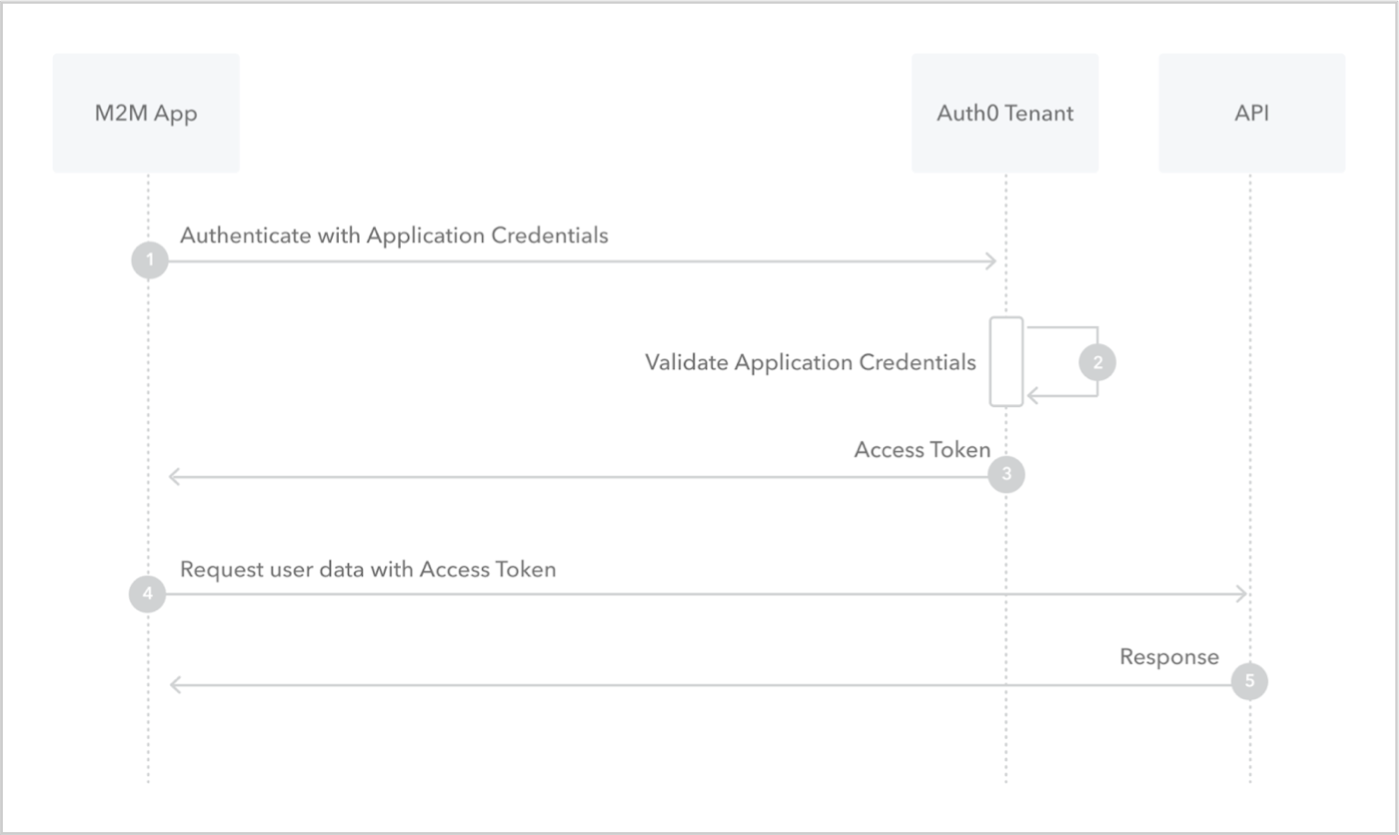
When your app needs to fetch user data from your API:

  1. Your M2M application authenticates with your Auth0 Authorization Server.
  2. Auth0 responds with an Access Token.
  3. The Access Token can be used to call your API and retrieve requested data.

For M2M applications, Auth0 uses the Client Credentials Flow.

Flow Overview for Machine-to-Machine Apps

Implementation overview

Exceeding the Rate Limit

Implementation overview

  1. 1

    Configure the sign-in methods

    Auth0 supports a wide range of authentication methods: regular username/password (users can be stored in Auth0 or your own database), social (i.e., Google, Facebook, and 50+ other providers), passwordless (email magic link, email code, and phone code), and enterprise (e.g., SAML-based, ADFS, Ping, Okta).

    Go to the dashboard and turn on the methods you want to allow; they will automatically show up in the login/sign-up page. By default, email/password and Google are enabled.
  2. 2

    Customize the sign-in UI (optional)

    The default experience is demonstrated in the image below and can be completely customized in the dashboard, from changing the logo and primary colors to completely overriding it with your own login screen.

    Default Login Screen for Native/Mobile Apps
  3. 3

    Use the Auth0 SDK to trigger the flow

    The SDK will take care of the details of opening the SafariViewController or Chrome Custom Tab, parsing the response back from Auth0, and validating the ID Token.

    Your app can store the Access Token and a Refresh Token used to renew the Access Token without asking the user to re-enter their credentials. Follow one of our Native/Mobile Quickstarts to get started with the integration.
  1. 1

    Configure your API

    Once you have created your API, you will need to authorize your M2M application and configure any scopes that applications can request during authorization.
  2. 2

    Get an Access Token

    Your app requests an Access Token from your Auth0 Authorization Server using the Client Credentials Flow.
  3. 3

    Call your API

    When your app calls your API, it includes the retrieved Access Token in the HTTP Authorization header.

To implement the Client Credentials Flow, follow our Backend/API Quickstarts. The "Calling your API" section shows the required steps.

Or, to use our API endpoints, you can follow our tutorial: Call Your API Using the Client Credentials Flow.

Keep reading

Keep reading

What's next


Ready to start building?