

subject_token—for Auth0 access, ID, and refresh tokens by calling the /oauth/token endpoint, in accordance with RFC 8693.
How it works
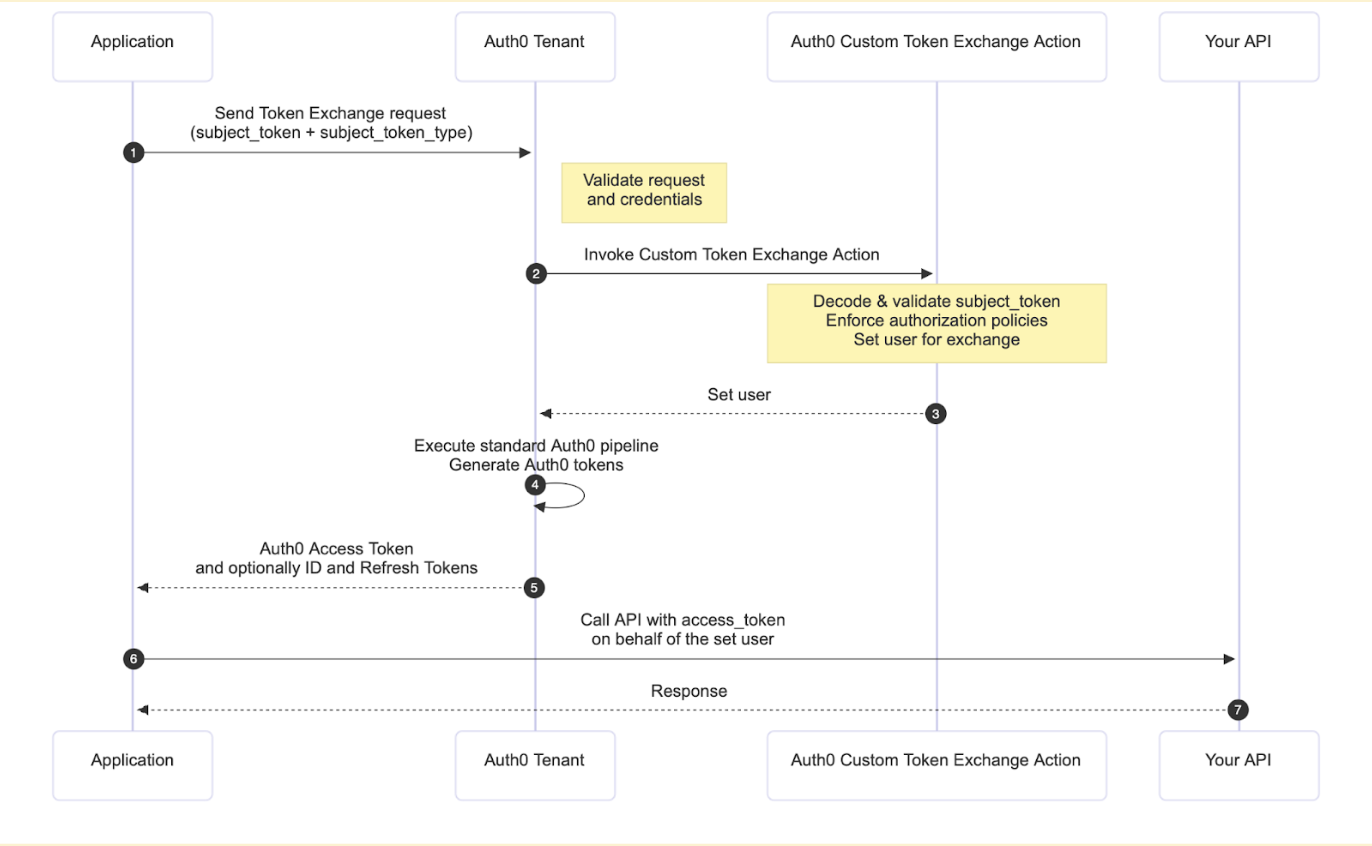
The Custom Token Exchange flow is governed by a single, dedicated Custom Token Exchange Action, which is uniquely selected based on the incomingsubject_token_type parameter, as configured in a Custom Token Exchange Profile.
subject_token_type to the Action that will handle the requests.
When the Custom Token Exchange flow is triggered:
- The application sends a
POSTrequest to the/oauth/tokenendpoint with the security token to be exchanged (thesubject_token) and its correspondingsubject_token_type. The request can optionally include anactor_tokenandactor_token_typeto identify a principal acting on behalf of the user. - Auth0 validates the client request and credentials.
- The associated Custom Token Exchange Action is executed. Your custom code must decode and validate the
subject_token, enforce any necessary authorization policies, and set the user for the transaction to approve the exchange. The Action can also set an actor for the transaction viaapi.authentication.setActor(), which results in anactclaim in the issued tokens that identifies who is acting on behalf of the user. - The rest of the standard Auth0 pipeline executes to generate an Auth0 access token and optionally an ID token and refresh token for the set user.
- The requesting application can then use these newly issued tokens to securely call APIs on behalf of the user that was set in the Action.
audience set to urn:YOUR_AUTH0_TENANT_DOMAIN:session_transfer returns a Session Transfer Token instead of an access token, which your application can redeem to establish a web session as another user. To learn more, read Session Delegation.
Get started
To use Custom Token Exchange, you need to create a Custom Token Exchange Profile. The general workflow involves three main configuration steps followed by your API call:- Create and deploy an Action that will contain the logic to control the token exchange. In this Action, write the custom code logic to:
- Securely decode and validate the incoming
subject_token. - Perform any required authorization steps for the transaction.
- Set the corresponding user for the transaction using the available methods in the Custom Token Exchange Actions API Object.
- Securely decode and validate the incoming
- Create the Custom Token Exchange Profile in your tenant. The profile establishes a one-to-one mapping between a specific
subject_token_typeyou will use in your requests and the Action you just created. - Enable Custom Token Exchange for your application.
- Call your API: You can now make a
POSTrequest to the/oauth/tokenendpoint with the necessary parameters, including thesubject_tokenand thesubject_token_typethat corresponds to your configured profile. To learn more, read Call your API using Custom Token Exchange.