

Fine-Grained Authorization (FGA) has fundamentally transformed how enterprises manage relationship-based access control (ReBAC). By moving beyond static roles, it allows organizations to define permissions based on real-time relationships. However, as enterprises move from simple prototypes to production-grade AI or challenging search scenarios, they often hit the same technological wall: Search With Permissions.
The challenge is simple, but difficult to solve at scale – Given a particular search filter and sort order, what objects can a user access?
The Standard Search Challenge
In a typical search scenario, a user enters a keyword into a search bar and expects to see results instantly. For example, if an employee searches for ‘Quarterly Forecasts,’ the system displays all matching files. However, in an enterprise environment, the system cannot simply return every match; it must verify that the user has specific access to view each result.
When hundreds of thousands or millions of documents are involved, checking permissions at query time can result in high latency responses. This often forces developers into a difficult tradeoff: a secure system that is too slow to use, or a fast system that risks sensitive data disclosure.
It gets even more complex when AI is introduced. An AI Agent performing RAG (Retrieval-Augmented-Generation) must perform the same ‘search with permissions’ to augment and generate a response, but does 100x more searches than a human. Customers need a purpose-built solution to handle authorization quickly and at this scale.
Introducing (Co-Located) Permissions Index
Today, we are announcing the FGA Permissions Index in developer preview. This feature is designed to handle authorization at an enterprise scale most traditional systems cannot achieve. The core innovation of the Permissions Index is an architectural shift that moves the high compute cost of authorization from query time to write time.
In a traditional relationship-based model, checking a permission requires the system to traverse a complex graph to find a valid path between a user and an object when the request arrives. The Permissions Index anticipates this time-consuming traversal by pre-calculating all permission combinations and storing them as direct 1:1 mappings. Whenever a relationship is added or revoked in FGA, an incremental compute engine cleverly remembers which parts of the graph are affected, quickly ‘flattens’ those relationships, and enables a simple, efficient lookup at query time, no real-time graph traversal necessary.
The Performance of Colocation
While the Permissions Index provides the logic for instant decisions, the co-located deployment model enables those decisions to happen right next to your business data.
In this model, the flattened set of permissions is streamed back to you and stored directly within your own environment. You can quickly evaluate permissions locally using simple SQL joins without making a single external API call. This removes the latency and overhead associated with external network dependencies.
The co-located architecture utilizes a specialized workflow to help ensure your local index remains fresh and performant:
- Real-time Event Streaming: Auth0 FGA identifies the impact of any relationship change in near real-time. These expanded permissions are then streamed as events directly into your local database, such as PostgreSQL, Snowflake, or ElasticSearch.
- Local SQL Joins: Because permissions are stored locally in a standard database format, your application or search engine can perform a simple local join between your business records and the precomputed permissions table.
- Constant-Query Latency: This architecture effectively solves the "fan-out" problem. Because answers are pre-calculated and available locally, query latency remains flat and consistent whether a user has access to 10 documents or 100,000.
To see this architectural shift in action and witness how real-time relationship updates instantly stream flattened permissions into a local environment for high-performance search filtering, check out our technical walkthrough below.
Key Enterprise Use Cases
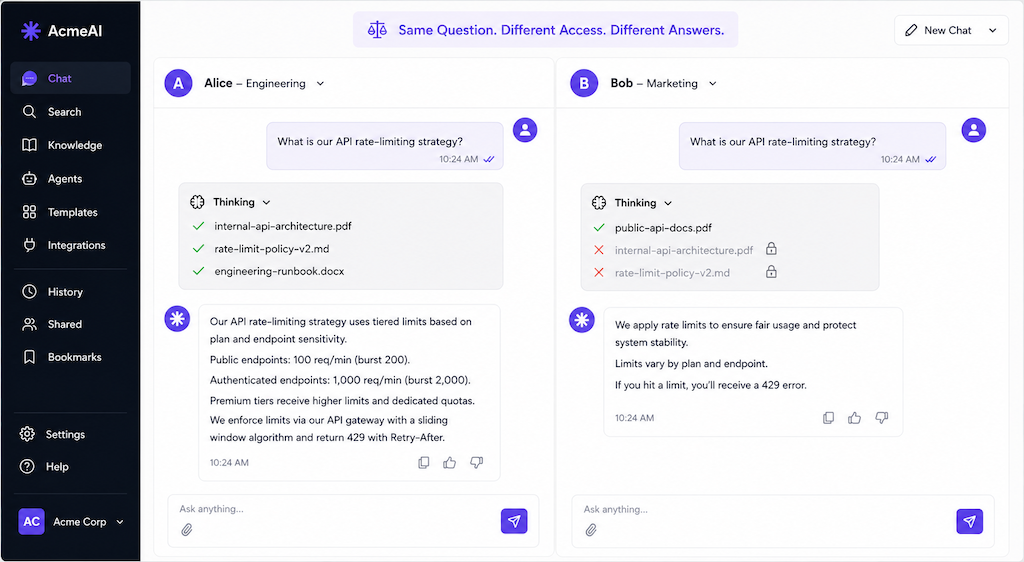
1. Secure RAG for AI Agents (chat with my data)
Sensitive Information Exposure is #2 on OWASPs (Open Web Application Security Projects) Top 10 risks for Large Language Models (LLMs) and a primary blocker for enterprises releasing AI into production. If an AI agent accesses sensitive HR or financial data during the data retrieval phase of Retrieval-Augmented-Generation (RAG) applications due to improper access control, the results can be catastrophic! The FGA Permissions Index acts as the first line of defense built to handle the scale of AI, ensuring the agent only retrieves records that the human requester is authorized to view.
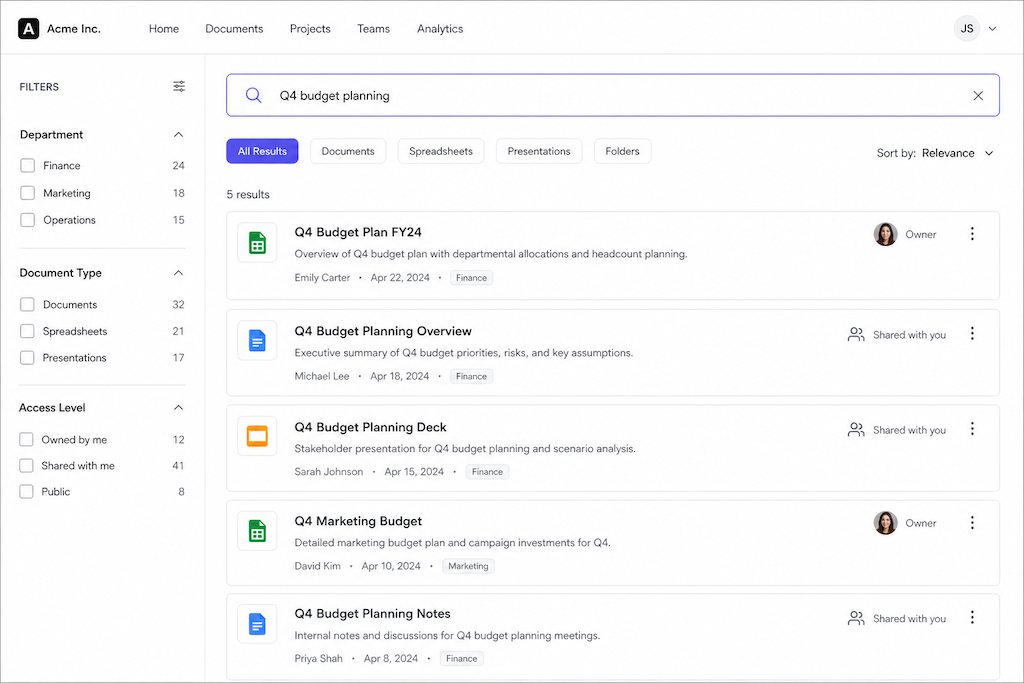
2. Enterprise search with permission-filtered results
In modern B2B applications, traditional RBAC (Role-Based Access Control) has become too coarse to handle the complexity of granular search requirements. While Fine-Grained Authorization (FGA) solves this by allowing you to define permissions based on real-time, relationship-based access, it introduces a new challenge at scale.
FGA Permissions Index bridges this gap. By streaming authorization data from your centralized authorization system and into your application environments, your search engine can perform a simple local join between your data and your permissions. This architectural shift results in instant, more secure search results without a single external API call at query time.
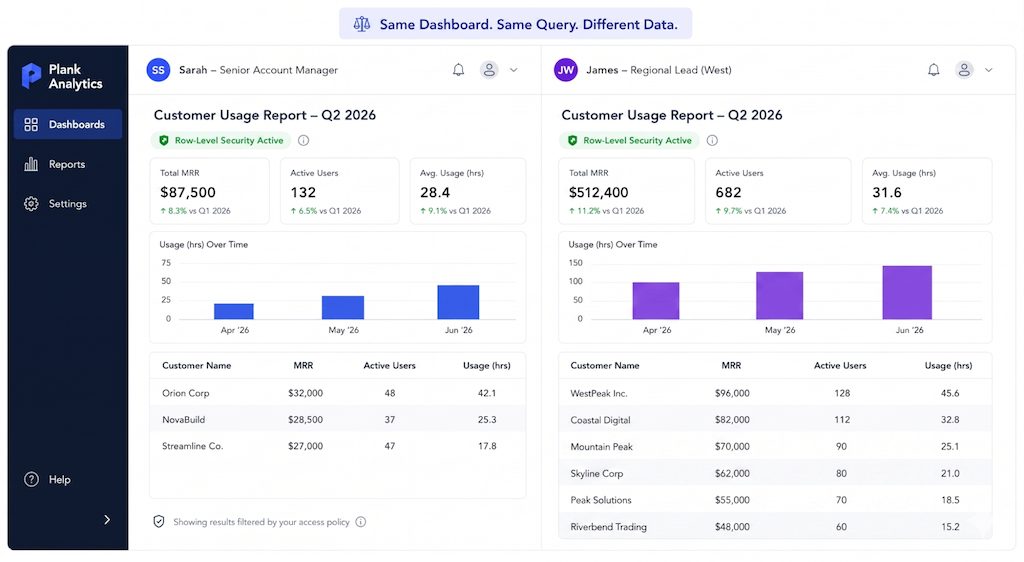
3. Row-level security for analytics
When users access shared analytics dashboards or Business Intelligence (BI) tools, ensuring they only see the specific rows relevant to them, based on their granted access, is notoriously difficult to manage across fragmented data silos. By integrating the FGA Permissions Index directly into your data warehouse, you can ensure that when an analyst pulls a customer usage report, they only see metrics for the specific customers they oversee. This creates a high-performance, "security-by-default" analytics environment where data is automatically pruned at the storage level through a row-level security policy without the overhead of managing thousands of individual database roles.
Instant Authorization at Scale with FGA Permissions Index
In summary, by shifting from reactive API calls to a pre-computed FGA Permissions Index, enterprise teams can finally bridge the gap between a successful prototype and a more secure, production-ready product. This authorization innovation provides the scalable foundation of trust required for the next generation of autonomous agents and intelligent data applications. Whether you are securing billions of records or building the future of AI-driven assistants, the Permissions Index helps ensure that your security and compliance move at the same speed as your innovation. The FGA Permissions Index is available now in developer preview. Move your high-stakes AI and search projects to production faster by flattening your most important permissions today.
Key Resources:
- FGA Permissions Index Technical Guide
- Getting Started with FGA Permissions Index
- FGA Best Practices
- Product Overview: Auth0 for AI Agents