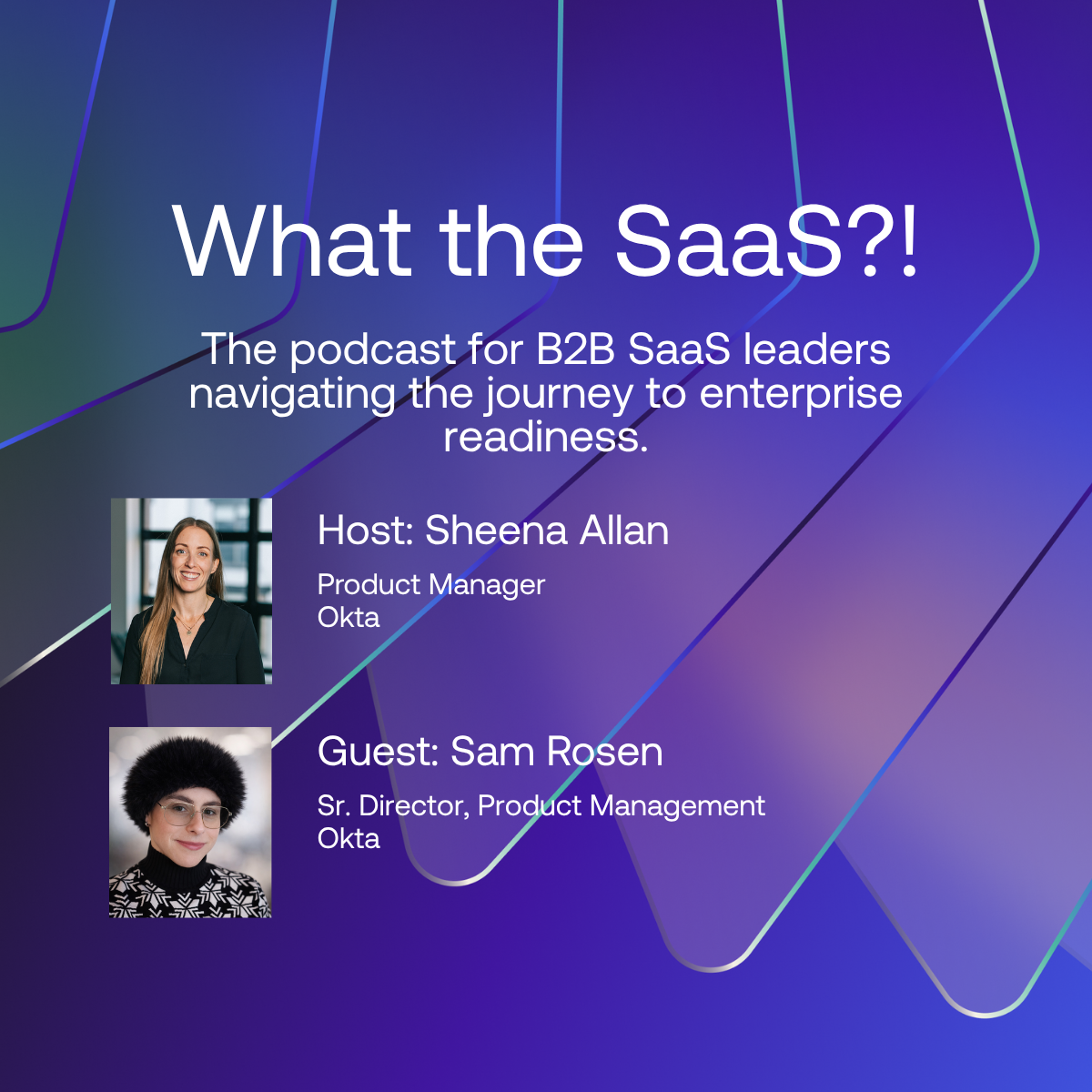
In the premiere episode of “What the SaaS?!,” our podcast for B2B SaaS leaders navigating the path to enterprise-readiness, I welcomed Senior Director of Product at Auth0, Sam Rosen. We dove headfirst into a challenge we see constantly: a growing B2B SaaS company finds product-market fit, but suddenly, its biggest deals get stuck.
We call this challenge the "Identity Wall," and it's the silent deal-killer for so many promising SaaS businesses. On the podcast, we define the “Identity Wall” and break down how to turn it into a revenue engine. Here’s a look at our conversation.
What Is The Identity Wall?
Most SaaS companies follow a classic evolution. You build a great B2C app, your user base grows, and you decide to chase the higher revenue of enterprise customers. But that first big contract negotiation is often a rude awakening.
And that’s the Identity Wall. The moment when your product runs into the real requirements of enterprise readiness, it’s not just about features anymore. Enterprise buyers start scrutinizing your identity architecture, security model, and operational scalability. You need to be ready to answer:
- “Do you support tenant isolation?” Preventing cross-organization leaks and enforcing strict isolation between users and data are often one of the first questions enterprise buyers ask.
- "Do you support SAML or OIDC?" A simple username/password box won't cut it. Enterprises live and breathe through Single Sign-On (SSO) providers like Okta, PingFederate, or Microsoft Entra ID. They expect you to integrate seamlessly.
- "How do you handle user provisioning?" Enterprise IT admins can't spend their days manually adding and removing hundreds of users in your app. They need System for Cross-domain Identity Management (SCIM) to automate this.
- "What happens when an employee leaves?" This is a critical security question. Your system must support instant de-provisioning, ensuring that when an employee is terminated, their access is revoked from a central identity provider.
If your answer to these questions is a blank stare, that deal is likely dead. To an enterprise, a simple, shared login system feels unprofessional and, worse, insecure.
Adopting a Tenancy-as-a-Service Mindset
Sam and I focused on the core strategic shift B2B SaaS builders must make: adopting a Tenancy-as-a-Service mindset.
The Tenancy-as-a-Service mindset is about treating each of your customers as a secure, self-contained unit. While you serve all your customers from a shared, multi-tenant infrastructure to control costs, you must create rigid security and data boundaries between them.
As we discussed on the podcast, identity and tenancy are inseparable. To know what resources a user can access, you first need to know who they are and which tenant they belong to.
The "Red Carpet" Experience
What I love most about this approach is the flexibility it offers. Sam used a phrase that perfectly captures it: the "red carpet" experience. Tenancy allows you to meet customers exactly where they are on their own security journey.
- For the simple customer: You can configure a basic email and password login for their specific tenant without compromising the security of others.
- For the advanced enterprise: You can roll out the "red carpet" with required MFA (Multi-Factor Authentication), support for passkeys, and direct integration with their specific workforce IDP.
This adaptability is what allows you to serve the entire market without alienating your most valuable customers.
What's Next? A Look at 2026 and the Rise of AI
Towards the end of our chat, Sam and I looked to the future. Tenancy isn't just about solving today's login challenges; it's about preparing for what's next.
As Sam put it, "Tenancy and AI are related... they become the mechanisms to create the boundaries for these agentic experiences."
In the near future, tenancy will be responsible for:
- Resource Governance: Managing not just logins, but also licensing and access to specific features or data within your application.
- AI Security Boundaries: As AI agents become more common, tenancy will provide a secure sandbox for them to operate in, ensuring one customer's AI can't access another's data.
Don't let your identity infrastructure be the roadblock that stalls your growth. By embracing a "Tenancy-as-a-Service" mindset today, you build an application that is flexible enough for today's enterprise requirements and secure enough for tomorrow's AI-driven world.
Be sure to tune into What the SaaS?! for more insights. In this monthly podcast series, we’ll continue exploring the core concepts of tenancy. Upcoming episodes will dive into topics like the role of Organizations, the power of self-service SSO, delegated administration, multi-custom domains, and more.
About the author

Sheena Allan
Product Manager