

According to the 2026 Customer Identity Trends Report, featuring global surveys of developers, senior leaders and consumers commissioned by Okta, when asked what represented “The single biggest threat to their business right now,” nearly a quarter (23.2%) of senior leaders from North American companies selected “competitive disruption from AI-native competitors,” second only to “cybersecurity and data risk” (31.4%).
Similarly, more than three-quarters of those same senior leaders reported that their business would be either moderately (46.3%) or highly (20.4%) exposed if a competitor launched a significantly better AI-driven customer experience tomorrow.
It’s little surprise, then, that just over half (50.2%) of North America’s senior leaders consider AI as a “must-win” capability. (And if that figure seems low, it’s worth noting that an additional 33.3% consider it to be “important”).
Unfortunately, evidence is mounting that North American companies are struggling to bring their AI visions to life—at the exact moment that consumers are poised to adopt AI-assisted customer journeys.
Key Takeaways
- AI is changing how customers expect brands to serve them—including imposing new requirements specific to agentic experiences.
- Brands need to make AI-assisted experiences useful, trusted, and easy to adopt, while catering to consumers’ desire to approve or reverse actions.
- More than three-quarters of North American brands are rolling out AI agents or autonomous systems, but only 22.1% are meeting project timelines.
- North America’s companies invest heavily in building and managing identity infrastructure, but less than 15% consider identity to be a competitive advantage Agentic commerce requires an identity platform built to meet the unique demands of agent authentication, authorization, auditability, and scale.
Consumer control Is the Gateway to Adoption of Autonomous Agents
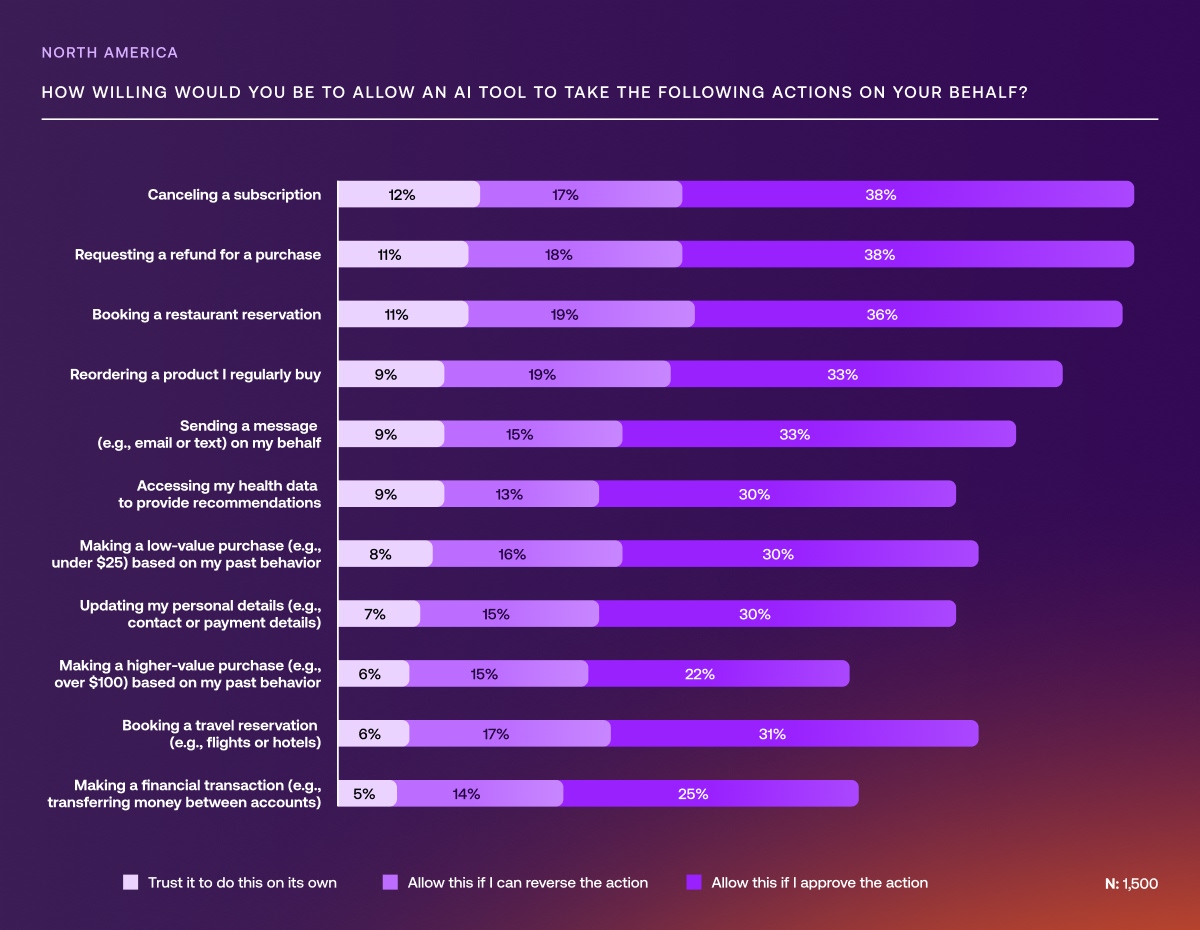
Only 37% of North American consumers are ready for AI to take on final decisions and take action on their behalf (7%) or to handle routine tasks and relatively less important decisions (30%) today. However, willingness to allow an AI tool to act on their behalf crosses the 50% threshold for most use cases when the consumer has to approve or can reverse actions.
Key Stats:
- 37% — Ready for AI to make decisions or handle routine tasks.
- 7% — Ready for AI to make final decisions and act.
- 30% — Ready for AI to handle routine tasks.
- >50% — Willing for most uses if actions can be approved or reversed.
As consumers come to trust and depend on these actions, brands with the most useful, convenient, and trustworthy agentic experiences will be poised to gain market share from competitors that lag behind.
When Customer Identity Isn’t Viewed Strategically, AI Innovations Are Slowed
More than three-quarters of North American developers and senior leaders polled reported that their company either already has AI agents or autonomous systems fully embedded in production (35.7%) or is actively building them (41.4%).
And yet, only 22.1% of those organizations are moving as quickly as they would like. When asked to identify the single biggest reason for the delays, nearly 20% of developers and senior leaders cited a lack of engineering capacity, while slightly more than 10% directly pointed to identity infrastructure that “can't support agent access patterns.”
Key Stats:
- 77.1% — Rolling out agents or autonomous systems.
- 35.7% — Agents already in production.
- 41.4% — Actively building agents.
- 22.1% — Moving as quickly as desired.
- ~20% — Engineering capacity cited as a delay.
- >10% — Identity cannot support agent access patterns.
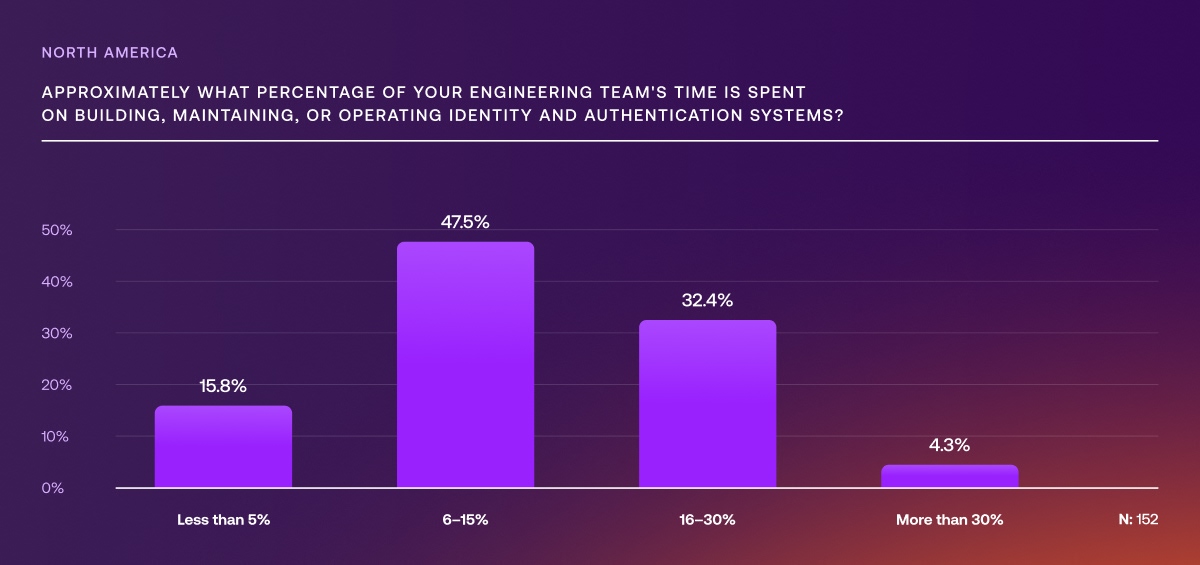
Looking more deeply, those same respondents reported that roughly 14% of their engineering team’s time is spent building, maintaining, or operating customer identity and access management (CIAM). And yet, for all that investment, not even 15% of those respondents consider identity “solved” to the point where it’s a competitive advantage.
In contrast, nearly twice as many (27.2%) say they’re only “managing,” and that “identity is a recurring cost and time drain we work around.”
Turning Identity Into a Growth Driver, Rather Than a Roadblock
For too many organizations, the pilot-to-production pipeline is slowed by customer identity that just can’t meet the needs of agentic customer experiences.
However, development doesn’t have to grind to a halt when customer identity and AI intersect. Organizations that rely on only an external customer identity platform are more likely to report:
- Employing security measures—including frictionless authentication—that safeguard interactions and contribute to trust, while protecting revenue
- Building the type of transformative AI or agentic capabilities that establish meaningful differentiation
- Having AI or agentic features fully embedded in production already, to win early adopters and establish leadership
- Being on schedule with their AI rollouts, avoiding delays that can compound and threaten AI ambitions
In short, the right platform takes care of the specialized details that can derail projects, allowing developers to focus less on building and maintaining identity, and more on leveraging it to power traditional and agentic customer experiences.
Unresolved identity friction is actively leaking revenue and creating new challenges for businesses deploying AI agents, where trust and control are critical. Read the 2026 Customer Identity Trends Report to explore how modernizing customer identity helps organizations deliver convenience without compromising security, reducing the friction that slows growth today while enabling the trust and control needed for AI-powered experiences.
Unless otherwise cited, all data in this brief comes from the surveys commissioned for the 2026 Customer Identity Trends Report.