
As global enterprises accelerate their digital transformation, identity has become the unified front door for massive, complex ecosystems. But as these ecosystems grow, so do the network requirements governing them.
Enterprise customers connect Auth0 to systems that handle sensitive data, where the path those requests travel matters. Compliance frameworks like PCI-DSS, HIPAA, and SOC 2 restrict data flows to private, auditable channels. Cloud-native architectures are built around VPC-native connectivity, not public endpoints. And at scale, routing authentication traffic over the public internet introduces latency and unpredictability that private networking eliminates.
Auth0 Outbound PrivateLink is built to satisfy stricter Enterprise requirements. It establishes a secure, private, unidirectional connection between your Auth0 environment and your cloud infrastructure, so traffic between Auth0 and your backend infrastructure in AWS never traverses the public internet.
What Is the Difference Between Unified Identity and Isolated Networks?
A common architectural pattern we see among large enterprises (such as global manufacturers, international hospitality brands, and financial institutions) is the desire to create a unified identity hub. Instead of standing up fragmented identity providers for every regional app, they centralize authentication into a single Auth0 environment.
A single Auth0 environment works brilliantly for identity consolidation, but it introduces a network topology challenge: strict virtual private cloud (VPC) isolation.
Enterprise security policies often dictate that Production networks and Staging/QA networks must live in completely isolated VPCs. Auth0 natively supports establishing one outbound PrivateLink connection per Auth0 private cloud environment.
If your Auth0 tenant needs to execute a Custom Database Action or a Post-Login webhook, how do you route that traffic to an isolated Staging VPC for your beta apps and to the Production VPC for your live apps, using only a single secure tunnel?
The Solution: The Intelligent Gateway Pattern
Instead of trying to force multiple parallel PrivateLink connections from a single environment, the most scalable approach is to deploy an API Gateway or reverse proxy (for example, NGINX, and HAProxy) at the PrivateLink termination point inside your AWS environment. This gateway becomes the receiving end of the PrivateLink connection and acts a fan-out layer.
Traffic arrives over one private connection, and the gateway routes it to as many internal services as you need. This decouples the secure transport layer (PrivateLink) from your internal routing and security needs.
Here is how the Intelligent Gateway Pattern architecture looks:
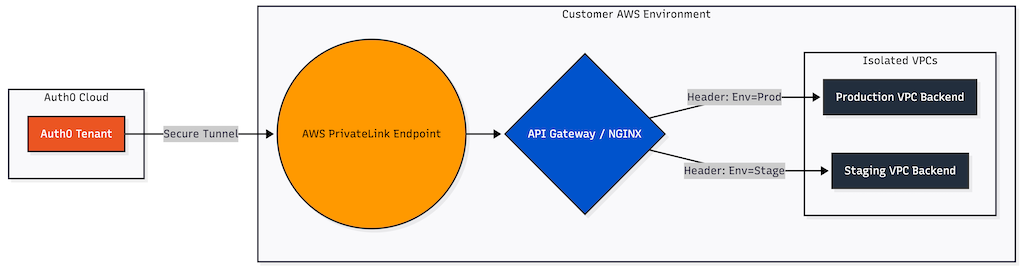
How the Intelligent Gateway Pattern works in practice
- The Single Secure Pipe: Auth0 establishes a single PrivateLink connection to an endpoint service hosted in a shared/DMZ VPC within your AWS infrastructure. All outbound traffic from Auth0 flows securely through this tunnel, never touching the public internet.
- The Intelligent Gateway: The PrivateLink endpoint forwards the incoming Auth0 traffic to your API Gateway or reverse proxy.
- Append Context via Auth0 Actions: Before Auth0 sends the request out, you can use Auth0 Actions to append specific context. For example, your Action code can append a custom HTTP header (for example, X-
Target-Env: staging), append a specific path to the URL (for example,/staging/api/users), or inject a specific JWT claim. - Traffic Distribution: The API Gateway inspects the headers, paths, or claims of the incoming request. Based on its configured routing rules, it acts as a traffic cop, forwarding Staging traffic to the isolated Staging VPC, and Production traffic to the Production VPC.
The Intelligent Gateway Pattern Unblocks Your Identity Strategy.
Extensibility is at the core of Auth0. Integrating Auth0 with cloud-native primitives like AWS PrivateLink and API Gateways unlocks architectural flexibility, letting your network and security teams maintain strict isolation rules while your identity architects maintain a unified, scalable Auth0 tenant.
If VPC isolation, data residency, or a legacy migration is complicating your identity strategy, do not let a single-connection limit dictate your architecture. Map your traffic segmentation needs, then talk to your Auth0 solutions engineer about tailoring the Intelligent Gateway pattern to your environment.
About the author

Daryl Martis
Senior Director, Product Management