

The Technology, Media, and Telecommunications (TMT) market is undergoing significant disruption as new entrants born in the digital age rise up to challenge traditional leaders. In this high-stakes battle, every player regards fast and convenient customer journeys as essential elements for increasing use and building loyalty. However, according to the 2026 Customer Identity Trends Report, featuring global surveys of developers, senior leaders, and consumers commissioned by Okta, TMT companies continue to be prime targets of cyber criminals, who routinely attack customer identity systems in an attempt to access sensitive data and gain control of legitimate accounts. For their part, customers recognize the need for security measures but expect these to be implemented in an unobtrusive manner. TMT companies that find the right recipe stand to reap significant rewards through the increased trust that such an outcome creates: when asked how important different aspects were to helping them trust apps/websites, 93% of consumers polled chose “the app/website provides strong security without making access difficult.”
Key Takeaways
- Trust — and all the benefits that come with it — rests on a foundation of strong security and convenient access (not one or the other).
- Technology, Media, and Telecommunications companies continue to endure constant attacks against customer identity systems, led by social engineering attacks against their customers, API abuse or unauthorized access attempts, and fake accounts.
- 19% of TMT companies report that they are losing customers because security friction is too high; another 25% don’t even have visibility into whether or not security is contributing to customer abandonment.
- Modern, external identity platforms allow TMT companies to secure the customer journey without harming conversion, retention, and other KPIs.
TMT Companies and Their Customers Are Under Attack
Only 11.1% of developers and senior leaders from TMT companies reported that they weren’t actively dealing with security or fraud challenges, while the remainder pointed to a long list of issues, including:
- Phishing or social engineering targeting their users (cited by 40.5% of those surveyed)
- API abuse or unauthorized system access (39.5%)
- Fake account creation at signup (36.8%)
- Bot traffic inflating engagement metrics or abusing promotions (35.8%)
- Credential stuffing or brute-force attacks on login flows (33.7%)
- Account takeover affecting legitimate users (26.8%)
- Loyalty or rewards program abuse (22.1%)
The challenge is clear: Technology, Media, and Telecommunication companies must implement robust security measures, but in a manner that doesn’t drive away legitimate users.
All Too Often, Security Measures Harm Customer Experiences
By treating customer identity as a core element of the user experience—rather than an isolated security gate — TMT companies can meet customer expectations and business needs for security, without disproportionately harming overall customer experiences.
Unfortunately, many Technology, Media, and Telecommunication companies are struggling to secure their customer identity infrastructure without harming the customer experience: 19.0% of senior leaders and developers from Technology, Media, and Telecommunication companies reported that they are losing customers because security friction is too high.
Almost as alarming, a further 25.2% said that they don’t even have visibility into whether or not their security measures are driving abandonment.
Key Stats: 19.0% — Losing customers due to security friction. 25.2% — No visibility into security-driven abandonment.
External Identity Platforms Enable Secure and Convenient Experiences
When asked how their approach to security affects the customer experience, developers exclusively using an external identity provider (rather than an in-house system, a legacy platform, or a hybrid approach) were the most likely to report that “This isn’t a problem for us yet.” In other words, their security measures don’t have any meaningful negative impact on the customer experience. What’s more, those same developers were also:
- The most likely to have implemented frictionless security, allowing them to manage risk without hurting conversion.
- The least likely to report that they’re losing customers because security friction is too high.
- The least likely to report not having the visibility needed to knowledgeably answer the question.
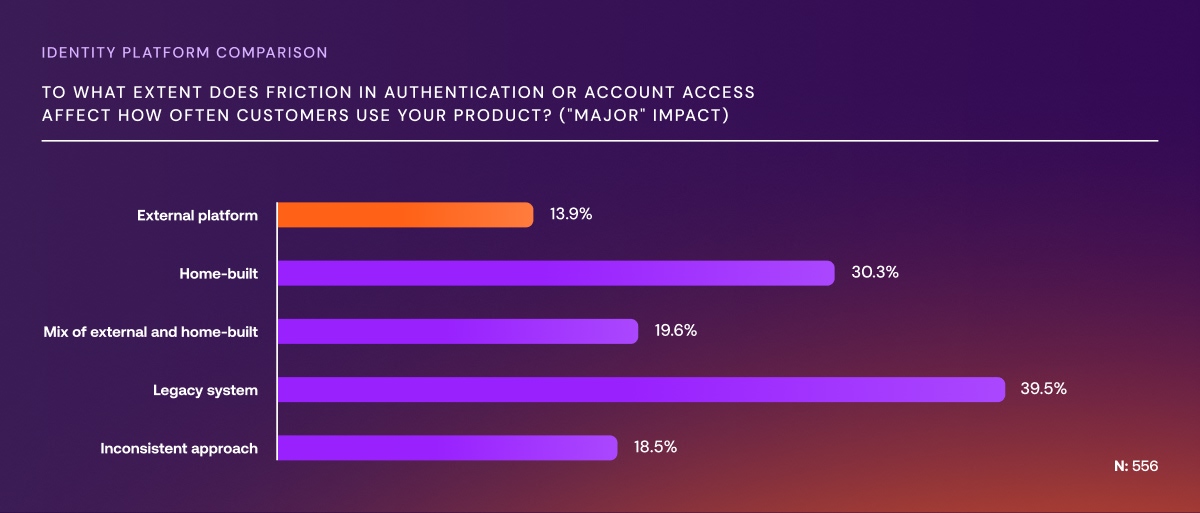
Moreover, developers and senior leaders within organizations that rely exclusively on an external customer identity platform are the least likely to report that their authentication experience: Has a “major” negative impact on customer retention Has a “major” negative impact on how frequently customers use their product Negatively impacts average order value per customer Negatively impacts purchase frequency.
Why do external identity platforms outperform alternatives? One reason is that they make it easy for developers to craft authentication experiences that introduce just the right amount of friction at just the right moments — warding off attackers without inconveniencing legitimate prospects and customers.
Unresolved identity friction is actively leaking revenue and creating new challenges for businesses deploying AI agents, where trust and control are critical. Read the 2026 Customer Identity Trends Report to explore how modernizing customer identity helps organizations deliver convenience without compromising security, reducing the friction that slows growth today while enabling the trust and control needed for AI-powered experiences.
Unless otherwise cited, all data in this brief comes from the surveys commissioned for the 2026 Customer Identity Trends Report.