

Healthcare and Life Sciences (HCLS) organizations are increasingly adopting AI agents with Amazon Bedrock and identity capabilities from Auth0 for AI Agents. Among all healthcare and life sciences organizations, roughly 79% report some level of AI adoption (according to Resources Global Professionals), and across all industries, around 69% of organizations cite security concerns (data leakage, over-privileged access, and unmanaged agent actions) as the primary barrier to scaling AI agents. This integration helps address these challenges while enabling a range of healthcare-specific use cases, from streamlining daily operations to supporting advanced applications. This post explains how this integration functions and highlights common HCLS applications.
HCLS Context: Practical Applications
For the critical infrastructure of healthcare organizations, AI agents offer a means to interact with patients and providers, significantly improving the care experience while maintaining compliance. The following use cases illustrate how the Auth0 for AI Agents and Amazon Bedrock integration delivers measurable, secure outcomes across two high-impact workflows.
Use case 1: AI-powered prescription management for pharmacy services
The Scenario
Today, a patient refilling a prescription may wait on hold, navigate an IVR system, or log into a portal — only to hit a wall when their prescription requires physician approval. The experience is fragmented, slow, and introduces risk when context is lost between steps.
By deploying an AI agent with Amazon Bedrock and secured with Auth0 for AI Agents, pharmacies can manage the prescription lifecycle end-to-end within a single, authenticated, continuous session.
How It Works
Step 1: Patient Authentication (Inbound)
The patient initiates a request (web, mobile, or voice). Auth0 for AI Agents authenticates the patient's identity, validating their credentials before the agent is permitted to act on their behalf.
Step 2: Session Context Preservation
The authenticated session context, including patient ID, prescription history, and insurance information, is carried securely throughout the entire interaction. Data does not need to be re-requested between steps.
Step 3: Agent Action with Scoped Permissions (Outbound)
The AI agent queries the pharmacy management system and EHR to retrieve the relevant prescription. Auth0 for AI Agents fine-grained authorization (FGA) means that the agent can only access records within the scope of that patient's session, not other patient records.
Step 4: Human-in-the-Loop Physician Approval
For prescriptions requiring physician sign-off, the agent automatically routes the request to the assigned physician for approval. The agent is paused pending human confirmation, preventing any autonomous action outside of its authorized scope.
Step 5: Fulfillment
Once approved, the agent completes the order and sends it to the pharmacy for fulfillment, closing the loop within a single authenticated session.
Use case 2: intelligent pre-visit triage and prior authorization
The Scenario
Prior to a patient visit, clinical and administrative staff are burdened with two parallel workflows: gathering meaningful clinical intake data from the patient, and navigating the complex prior authorization (PA) requirements of payers. Both are time-intensive, error-prone, and heavily manual. The cost of PA alone is estimated at $13.30 per transaction in staff time for providers.
The Auth0 for AI Agents and Amazon Bedrock integration enables a single agent, or coordinated multi-agent workflow, to handle both simultaneously, securely, and while supporting HIPAA controls.
How It Works
Step 1: Patient Intake and Intelligent Triage
Before the appointment, an AI agent engages the patient to gather structured symptom data, clinical history, and relevant social determinants of health (SDOH). Unlike static intake forms, the agent asks dynamic follow-up questions based on the patient's responses, surfacing clinically relevant nuance.
Step 2: PHI Scoping and Care Team Access Controls
Auth0 for AI Agents fine-grained authorization means that the clinical notes and summaries produced by the agent are accessible only to the care team assigned to that patient. Role-based and document-level access controls prevent unauthorized access — even by other clinicians within the same organization.
Step 3: EHR Population
The agent automatically populates the pre-visit summary and clinical notes directly into the EHR, reducing documentation burden on clinical staff so that the attending provider arrives at the visit with a structured, complete picture.
Step 4: Concurrent Prior Authorization Submission
In parallel, the agent identifies procedures or medications likely to require prior authorization. It gathers the required clinical documentation, maps it to the relevant payer's criteria, and submits the PA request, or drafts a denial appeal, without manual staff intervention.
Step 5: Audit Trail Generation
Every agent action, every query, document access, and submission is logged in an auditable record trail. This supports both internal compliance reviews and external regulatory requirements.
The Integration: Auth0 for AI Agents and Amazon Bedrock
As previously announced, the Auth0 for AI Agents integration with Amazon Bedrock simplifies the deployment of secure AI agents, helping eliminate the security and technical debt associated with managing them.
Amazon Bedrock enables organizations to deploy and scale AI agents using foundation models from providers such as Anthropic, AWS, and OpenAI — Auth0 for AI Agents is critical for securing the agent's identity lifecycle, specifically at two key points:
- Inbound Authentication: Validating that the user accessing the AI agent is properly credentialed and authenticated.
- Outbound Authorization: Confirming the agent's access to specific data and backend systems.
Furthermore, Auth0 for AI Agents provides fine-grained authorization (FGA), enabling highly specific permissions at the agent, role, and document level.
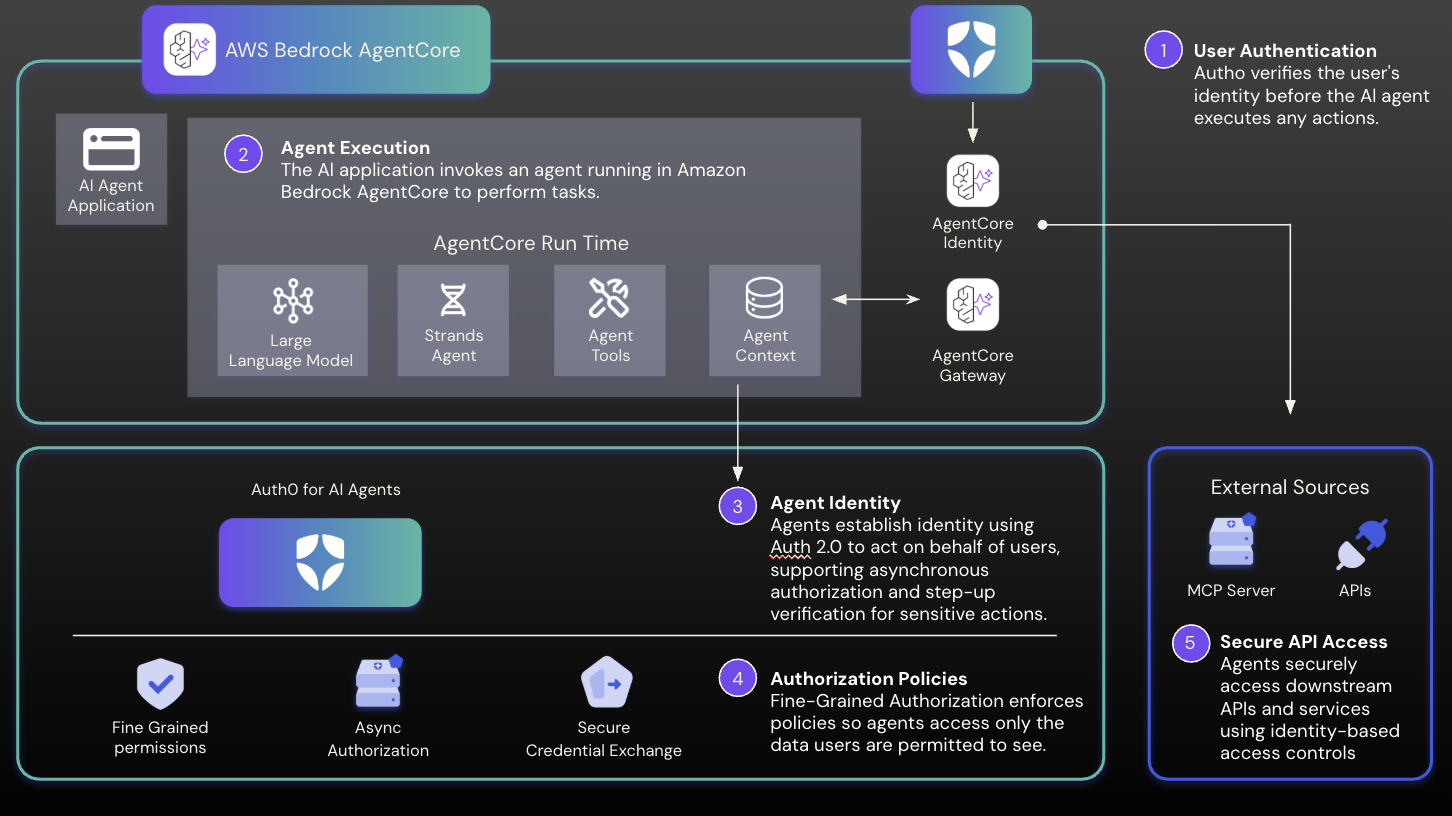
The Auth0 for AI Agents integration with Amazon Bedrock AgentCore flow is:
- Auth0 verifies the user's identity before the AI agent executes any actions
- The AI application invokes an agent running in Amazon Bedrock Agent Core to perform tasks
- Agents establish identity by using Auth 2.0 to act on behalf of users, supporting asynchronous authorization and step-up verification for sensitive actions.
- FGA enforces policies so agents access only the data users are permitted to see.
- Agents securely access downstream APIs and services using identity-based access controls.
Next Steps
Ultimately, the success of AI in healthcare hinges on the strength of identity and cloud infrastructure. Organizations must look toward a modular architecture where:
- Cloud infrastructure provides the scale and reliability required for AI workloads
- Foundation models provide clinical reasoning and automation
- Customer identity platforms enforce secure, policy-driven access to sensitive healthcare data
To begin using this integration, consult our step-by-step guide on securing Amazon Bedrock Agents with Auth0. You can also learn more about Auth0 for healthcare.