

McKinsey estimates that, by 2030, $3-5 trillion US dollars will flow through agentic commerce globally, and roughly 25-40% of all e-commerce will be agentic Retailers around the world are keen to make this vision a reality. According to the 2026 Customer Identity Trends Report, featuring global surveys of developers, senior leaders and consumers commissioned by Okta, more than two-thirds of retailers have either already introduced AI-powered or agentic systems into customer-facing products (28%) or are actively building these capabilities (39%).
However, these transformation initiatives will only deliver positive outcomes if retailers:
- Continue to balance convenience and security within each customer journey.
- Equip consumers with the right controls and transparency to overcome the AI trust gap.
- Have a customer identity and access management (CIAM) platform that makes it easy to craft AI-assisted experiences at scale.
Key Takeaways
- 67% of retailers are introducing AI-powered or agentic systems into customer-facing products.
- Consumers expect their digital experiences to seamlessly combine security and convenience, whether or not they involve AI.
- Retailers are already under attack, and agentic and autonomous systems introduce new risks.
- Few consumers are ready to delegate actions to AI, but the majority are willing to do so when actions need prior approval and can be undone.
- External identity platforms allow retailers to craft highly convenient and secure experiences — and evidence is mounting that they also enable superior outcomes for customer-facing AI initiatives.
Consumers Are Highly Sensitive to Interrupted Journeys
Retailers invest heavily in acquisition marketing, but all too often visitors leave before completing a purchase. And while there are many reasons why a user may fail to convert (e.g., window shopping, unexpected fees, etc.), identity-related friction continues to account for a meaningful share of lost revenue. However, friction itself isn’t inherently bad or good:
- The right amount of friction at the right moment can build trust (e.g., biometric identity verification prior to completing a purchase or viewing personal data)
- However, friction that’s disproportionate to the perceived action contributes to abandonment (e.g., forcing account creation or a long form fill before providing access to basic information)
Consequently, retailers shouldn’t aim to eliminate friction altogether, but to ensure it’s proportionate to the interaction.
Crucially, this point is true regardless of whether the customer journey is a ‘traditional’ one that’s manually driven, or an AI-assisted one—but the addition of AI features raises the stakes by increasing risk (for consumers and brands) and by introducing new authentication and authorization considerations.
We asked 5,250 consumers from around the globe what would cause them to abandon what they were doing when using apps or websites. The top three responses were:
- 74% — Being asked to create an account before seeing key information.
- 72% — Login or verification processes that take too long.
- 71% — Being asked to verify my identity multiple times during a task.
Retailers Are Already Under Attack, and Agentic Workflows Add New Risks
Retailers are already a top target for threat actors, who frequently seek the personal details and financial information within customer accounts, and have devised ways to take advantage of promotions and abuse loyalty/rewards programs.
Only 10% of developers and senior leaders from retailers reported that they weren’t actively dealing with security or fraud challenges. The remainder cited a long list of issues:
- 42% — Fake account creation
- 38% — Loyalty/rewards program abuse
- 37% — Brute-force login attacks
- 37% — Bot traffic distorting metrics
- 37% — Account takeover attacks
- 34% — API abuse
Unfortunately, there’s every expectation that the situation will only get worse:
- AI technologies are easily weaponized, making it possible for anyone (regardless of technical acumen) to plan and execute large - scale attack campaigns
- AI agents, autonomous systems, and the APIs they use vastly expand the threat surface, and threat actors regard them as prime avenues for accessing sensitive and otherwise valuable information.
Protecting AI agents, autonomous systems, and the APIs they use requires an evolved approach to identity—one that links agents to individual customers and uses tightly scoped, time-limited credentials to control what agents can access and do.
The challenge is clear: retailers must implement robust security measures to safeguard against traditional threats and new ones, but in a manner that doesn’t drive away legitimate users.
There’s an AI Trust Gap, but Giving Consumers Control Can Close It
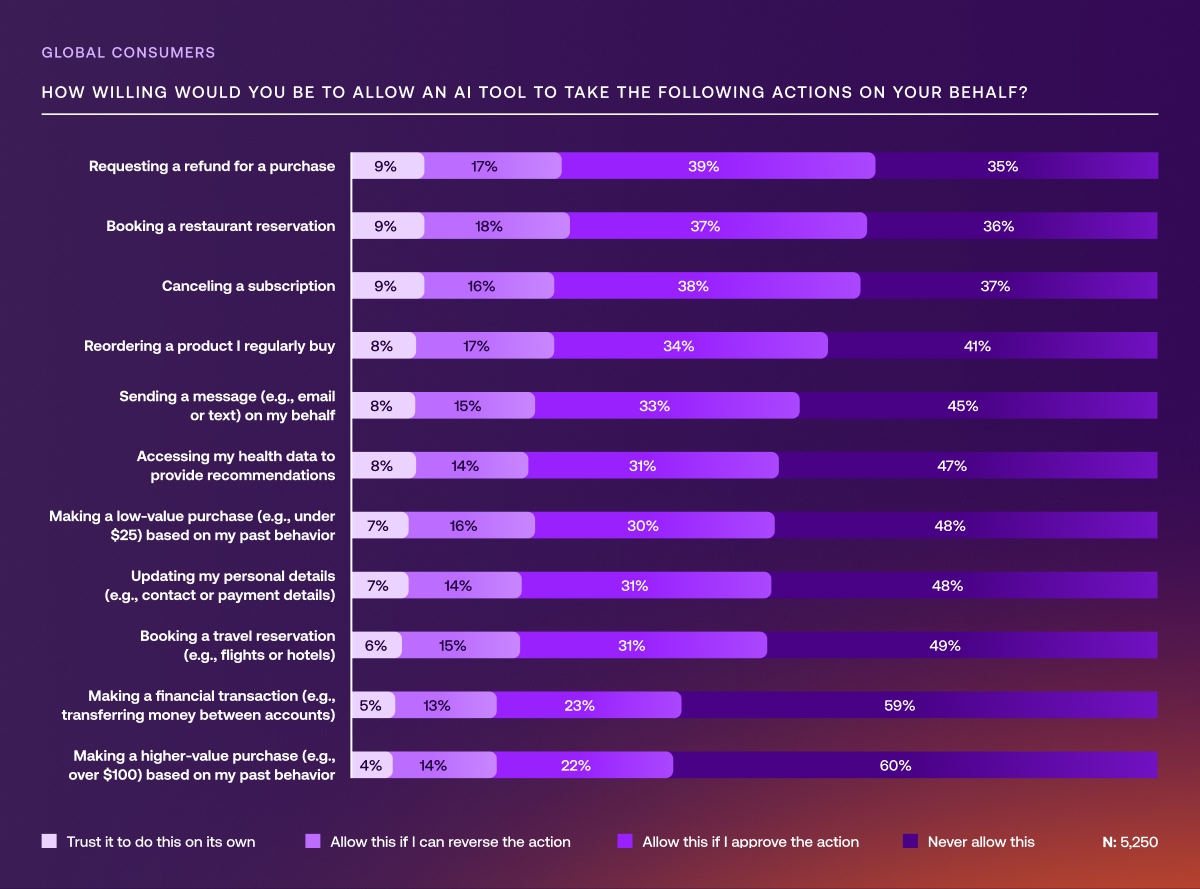
Only 6% of global consumers surveyed reported that they’re ready for AI “to handle as much as possible,” including “taking actions on my behalf.”
However, some simple controls can help close this “trust gap.” In fact, for use cases where the potential financial or personal consequences of an error are limited, the majority of consumers are willing to allow AI to act on their behalf so long as they approve the action first, or have the option to reverse it.
External Customer Identity Platforms Deliver the Seamless Experiences Consumers Demand — Whether or Not Those Experiences Involve AI
Customer identity is complicated enough, and agentic systems introduce an entirely new layer of complexity.
For many retailers, as AI ambitions grow, the pilot-to-production pipeline is slowed by a seemingly never-ending stream of technical hurdles, security surprises, and integration considerations.
But development doesn’t have to grind to a halt when customer identity and AI intersect. A modern CIAM solution, purpose-built for the agentic era:
- Centralizes authorization in the identity layer, keeping policies consistent, adaptive, and auditable while enabling and securing cross-app and cross-service agentic access
- Provides patterns for modeling agents distinctly, so each action is intentional and auditable, and enables agents to act safely and autonomously at scale
- Enforces fine-grained authorization (FGA), audit trails, and identity verification for agent actions, helping satisfy regulatory requirements
- Moves identity and permissions into the platform so that new agents can onboard quickly and policies can evolve automatically, while teams retain complete oversight and auditability
In short, the right customer identity platform takes care of the specialized details that can derail projects, allowing developers to focus less on building and maintaining identity, and more on leveraging it to power traditional and agentic customer experiences.
When asked how their approach to security affects the customer experience, developers and senior leaders from organizations that only use an external identity provider were the least likely to say that their authentication experience:
- Has a “major” negative impact on customer retention
- Has a “major” negative impact on how frequently customers use their product
- Negatively impacts average order value per customer
- Negatively impacts purchase frequency
Not coincidentally, these same respondents were the most likely to report that they’ve invested in frictionless security, allowing them to secure experiences without hurting conversion.
Plus, evidence is mounting that an external platform provides the best foundation for AI initiatives.
- Organizations that use only an external identity platform are the most likely to be building agentic capabilities.
- 34% of organizations that use only an external identity platform already have AI or agentic features fully embedded in production today, compared to only 22.3% of organizations using a different approach.
- 28% of organizations that use only an external identity platform are meeting AI project timelines, compared to only 18% at organizations that use a legacy, home-built, or hybrid identity stack.
Unresolved identity friction is actively leaking revenue and creating new challenges for businesses deploying AI agents, where trust and control are critical. Read the 2026 Customer Identity Trends Report to explore how modernizing customer identity helps organizations deliver convenience without compromising security, reducing the friction that slows growth today while enabling the trust and control needed for AI-powered experiences.
Unless otherwise cited, all data in this brief comes from the surveys commissioned for the 2026 Customer Identity Trends Report.