TL;DR: Auth0 Agent Gateway is a Customer Identity and Access Management (CIAM) control plane that enables SaaS teams to more securely govern and authorize product-native, customer-facing AI agents. It simplifies identity-bound execution, credential delegation, and policy enforcement, helping teams deliver secure AI experiences faster while ensuring robust multi-tenant data protection.
AI agents are moving from prototypes into the products customers use every day. As SaaS product companies adopt AI, they are generally pursuing two approaches:
- Open agent protocols: Exposing standardized interfaces, such as the Model Context Protocol (MCP), that let external agents discover and use application capabilities.
- Product-native agents: Building AI agents directly into your product, where they can use product context and take actions for customers.
Open protocols can make application capabilities accessible to external agents such as ChatGPT, Gemini, and Claude. For SaaS vendors building AI directly into their products, product-native agents offer a way to deliver more contextual, differentiated customer experiences. As these agents begin to take real-world actions across multi-tenant customer environments, identity and authorization become critical.
Today, we are announcing the beta of Auth0 Agent Gateway, a CIAM control plane that helps SaaS teams govern which customer-facing agents can access which tools, data, and connected accounts.
Why Customer-Facing Agents Need a Different Identity Model
Many agent-security approaches were designed around workforce use cases: employees accessing data inside a single organization. Customer-facing agents in multi-tenant SaaS products require a different trust model, one built around organizations, delegated user access, and customer consent.
| Architectural Dimension | Workforce Identity (Internal Agents) | Customer Identity / CIAM (Product-Embedded Agents) |
|---|---|---|
| Identity Boundary | Typically operates within one organization, for employees using managed corporate identities. | Operates across many customer tenants, each with its own users, roles, and data boundaries. |
| Who Owns Connected Accounts | Third-party accounts and integrations are usually centrally managed by one enterprise IT team. | Connected accounts may be owned and authorized independently by each customer tenant and end user. |
| Authorization Context | Access is primarily evaluated against an employee’s corporate role and internal policies. | Actions are evaluated in the context of the agent, user, organization, delegated permissions, and applicable customer authorization requirements. |
| Security Objective | Help protect internal data while enabling employee productivity. | Help enforce organization-aware access, prevent cross-tenant actions, and provide auditable control over agent tool use. |
In many workforce deployments, third-party SaaS accounts are centrally managed by an enterprise IT team. In CIAM, your SaaS platform must manage and broker access to external SaaS accounts owned individually by thousands of distinct customer tenants and end-users, each with their own credentials, permission tiers, and consent requirements.
For customer-facing agents operating across tenants and connected third-party accounts, teams may need controls beyond those commonly used for workforce-focused deployments or static API-key-based integrations. Failures in policy evaluation or context scoping can lead to cross-tenant data exposure, unauthorized third-party actions, or prompt-injection-driven misuse of connected tools.
How Auth0 Agent Gateway Helps Govern Customer-Facing Agents
The Auth0 Agent Gateway sits between your AI agent and the tools it can call, helping ensure that each action is evaluated in the context of the agent, user, and organization. It builds on Auth0 capabilities — including Organizations, Agents as Principals, Token Vault, token exchange, and tenant logs, to help teams manage authorization at agent runtime.
| Pillar | How Auth0 Agent Gateway Solves It | Strategic Impact for SaaS Builders |
|---|---|---|
| Identity-Bound Execution | Associates each tool call with the agent, organization, and user context—preserving the delegation chain behind every action. | Helps enforce organization-aware boundaries and reduce the risk of privilege escalation or cross-organization access. |
| Tool Call Authorization | Real-time policy evaluation before an agent can invoke any external tool. | Helps enforce least-privilege tool access by evaluating what an agent is authorized to do at each step. |
| Token Management & Credential Brokering | Leverages Token Vault and token exchange to mint user-scoped tokens for internal and external APIs, while issuing a short-lived Agent Gateway-only token to agents. | Helps keep raw API keys and downstream tokens out of LLM prompts, agent runtimes, context windows, and logs by issuing short-lived gateway tokens to agents. |
| Comprehensive Audit Logging | Logs every agent action to tenant logs, and optionally streams to Security Information and Event Management (SIEM) services. | Supports enterprise security reviews by providing auditability for customer security teams. |
| Agent Kill Switch | Provides centralized administrative controls to disable an agent or restrict its access to downstream services and tools. | Helps teams respond quickly to suspected breaches or runaway behavior. |
Multi-Tenant Authorization in Action: Project0
Consider Project0, a hypothetical B2B project-management platform with a product-native AI agent. Project0 serves two customers: Acme, which uses Slack, and Hooli, which uses Microsoft Teams.
When a user asks, “Summarize ProjectX and post it to #projectx-team,” the available action depends on the organization they are signed in to. For Acme, the agent can use the authorized Slack connection; for Hooli, it can use the authorized Microsoft Teams connection.
Consider Project0, a hypothetical B2B project-management platform with a product-native AI agent. Project0 serves two separate customer organizations:
- Acme, where Ric has connected a Slack account.
- Hooli, where Amy has connected a Microsoft Teams account.
Both organizations use the same Project0 Agent, but their identities, connected accounts, and available tools remain separate.
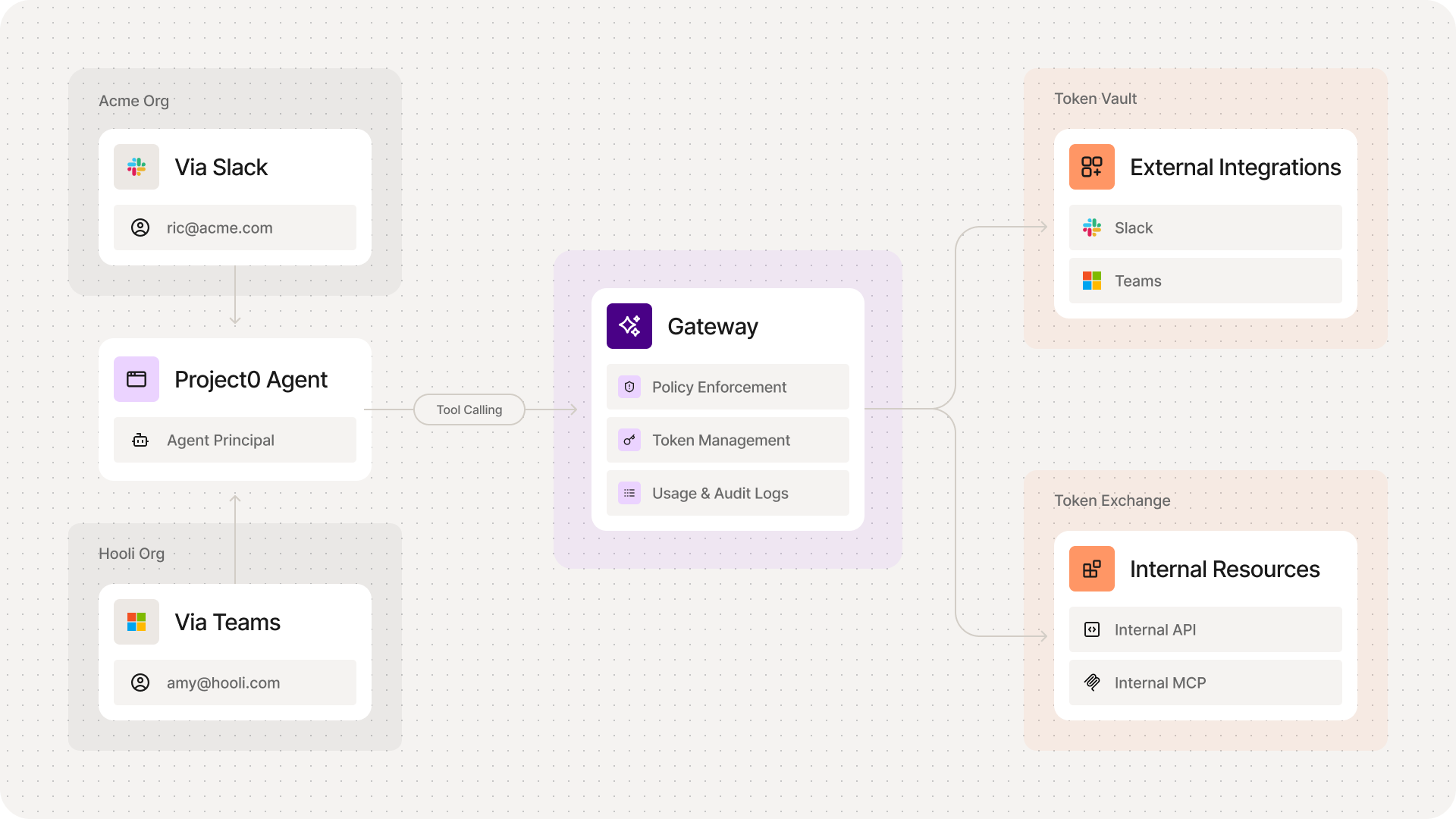
When Ric at Acme asks, “Summarize ProjectX and post it to #projectx-team,” the Project0 Agent sends the tool request to Auth0 Agent Gateway with the relevant agent, user, and organization context. The gateway evaluates the request against Acme’s authorization policies, retrieves the authorized Slack credential from Token Vault, and allows the agent to post the summary to Acme’s Slack workspace.
If Amy at Hooli makes the same request, the agent uses the same gateway endpoint, but the request is evaluated in Hooli’s context. The gateway applies Hooli’s policies and uses Amy’s authorized Microsoft Teams connection instead. The agent can access only the tools and credentials authorized for the current user and organization; it cannot use Acme’s Slack connection while acting on behalf of Hooli.
In both cases, Auth0 Agent Gateway provides a centralized point for policy enforcement, credential management, and usage and audit logging. It can also broker access to Project0’s internal APIs and internal MCP tools through Token Exchange.
What Identity and Governance Capabilities Can Auth0 Agent Gateway Help You Build?
For a single workflow, this may sound straightforward. At production scale (across tenants, tools, connected accounts, and enterprise security requirements), the underlying identity and governance work adds up quickly.
For enterprise buyers, AI initiatives can stall over concerns about data boundaries, unvetted tool access, and limited auditability.
Building these capabilities in-house can require significant work across identity, policy enforcement, credential management, audit logging, and operational controls.
| Capability | What Teams May Need to Build | Auth0 Agent Gateway |
|---|---|---|
| Secure Token Storage | Build and operate a credential vault to store and refresh user-authorized credentials for third-party integrations. | Use Auth0 Token Vault to manage credentials for connected services. |
| Credential Delegation | Build and maintain on-behalf-of token exchange flows to safely delegate user authority. | Use on-behalf-of token exchange to issue short-lived, scoped tokens for authorized actions. |
| Multi-Tenant Routing | Isolate MCP servers and user credentials for each tenant. | Apply organization-aware execution to help isolate access across customer tenants. |
| Dynamic Tool Filtering | Build a policy layer to filter, restrict, and authorize APIs by customer and conversation context. | Use a centralized policy layer that evaluates tool authorization at runtime. |
| Enterprise Log Pipelines | Build pipelines to stream action logs to customer SIEM platforms. | Use centralized logging with options to export relevant agent activity to SIEM tooling. |
| Emergency Control Plane | Build centralized controls to disable agents or MCP servers on a per-tenant basis. | Use centralized administrative controls to disable agents or restrict downstream tool access across a tenant or deployment. |
Capabilities and implementation requirements vary based on your architecture, existing tooling, and integration requirements.
With Auth0 Agent Gateway, teams can spend less time building foundational identity and governance controls, and more time delivering product-native AI experiences.
Join the Auth0 Agent Gateway Beta
We are looking for product and engineering teams building customer-facing, product-native AI agents in multi-tenant applications. Apply for Beta access to the Auth0 Agent Gateway to help shape a CIAM-first approach to building and governing customer-facing AI agents. Bring product-native AI experiences to market with stronger identity controls. Beta access gives you:
- Early platform access: Integrate with Auth0 Agent Gateway APIs during the beta.
- Implementation resources: Access documentation, integration guides, and examples.
- Direct collaboration: Connect with Auth0 product and engineering teams through dedicated Slack channels.
About the author

Andrés Aguiar
Director, Product Management
I’ve been at Auth0 since 2017. I’m currently working as a Director, Product Management for the Auth0 FGA and OpenFGA products. Previously, I worked in the teams that owned the Login and MFA flows.
I spent my entire 20+ year career building tools for developers, wearing different hats. When I'm not doing that, I enjoy spending time with my family, singing in a choir, cooking, or trying new kinds of local cheese.