In our first episode of What the SaaS, we named the identity wall: the moment a B2B SaaS company discovers that their consumer-grade auth setup will not survive contact with an enterprise procurement team. In our second, we laid out the architectural solution, the Organizations model, that makes true multi-tenancy possible.
But knowing the right architecture is only half the battle.
The harder question is what happens next because building a robust identity layer is one thing. Getting enterprise customers to trust it, adopt it, and stay protected by it, at speed, at scale, under real-world conditions, is something else entirely.
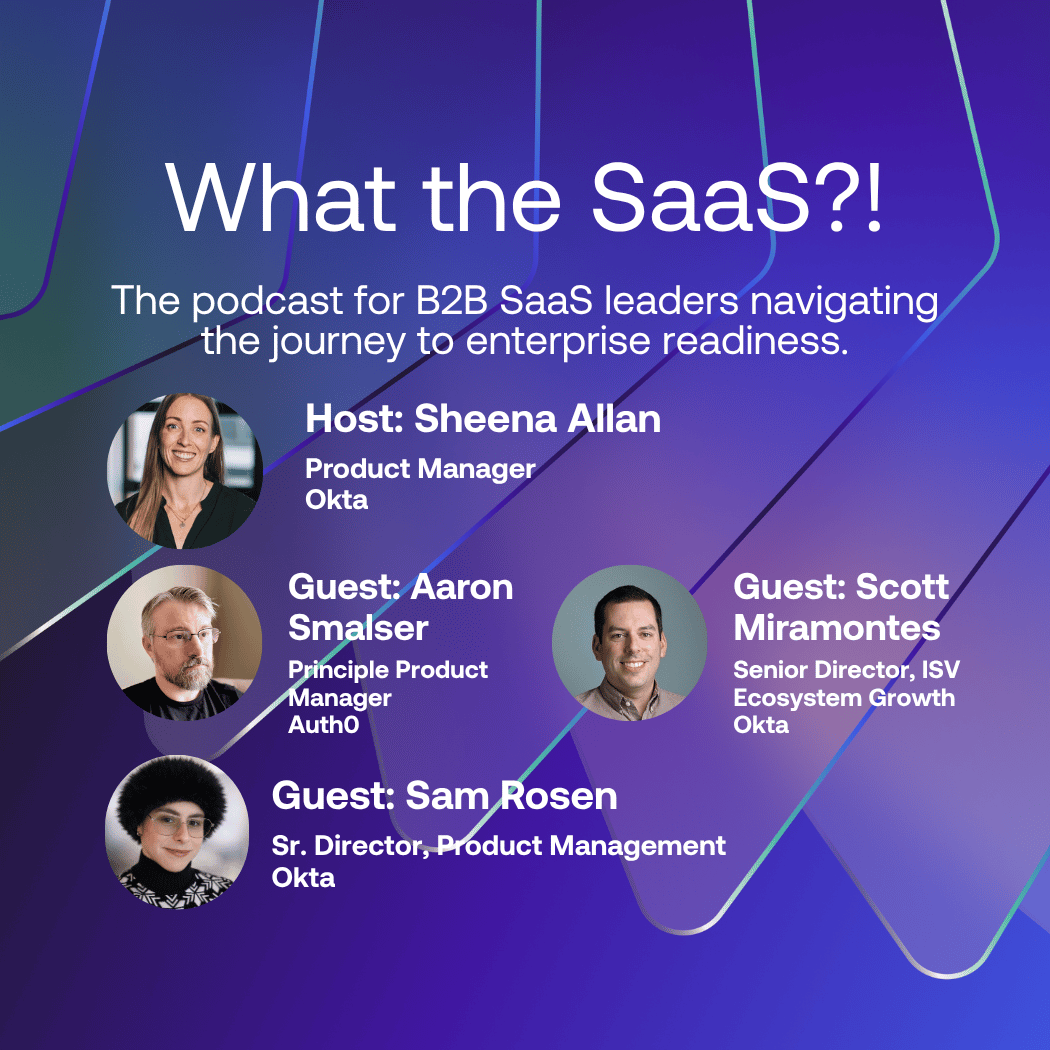
That is the question I brought to a powerhouse panel in Episode 3. Aaron Smalser (Product Architect, Auth0), Scott Miramontes (Senior Director of ISV Ecosystem Growth, Okta), and Sam Rosen (Senior Director of Product, Auth0) joined me to unpack three capabilities that, together, create what I have started calling the Trust Stack: the Okta Integration Network, Express Configuration, and Universal Logout.
Here is what I took away from the conversation.
The Problem Is Bigger Than Onboarding
Sam reframed something early in the conversation that I have not been able to stop thinking about.
The challenge is not just getting enterprise customers set up. It is that the number of identity features they expect is growing, and so is the surface area for things to go wrong.
"There are 20 or 30 other identity features coming around the corner that are going to make SaaS companies more and more secure, and the AI threat landscape is only going to make that list get bigger and bigger. The biggest issue for a SaaS vendor starts to become: how do you onboard a customer? How do you get them onto your platform? More importantly, how do you make sure they did it correctly?"
This is the tension at the center of the enterprise identity problem. The more powerful your security posture, the more configuration steps stand between you and the customer who is actually protected. And if they get even one of those steps wrong, the whole thing falls apart.
The Trust Stack is Auth0 and Okta's answer to that tension.
The Okta Integration Network: Someone Else Vouches for You
The best analogy Sam offered was the App Store, and it is a good one.
When a user downloads an app from the Apple App Store or Google Play, they do not start from zero. Someone has already vetted that the application is safe, that it meets platform standards, that it was built correctly. Trust is pre-established before the first interaction.
The Okta Integration Network (OIN) works the same way for enterprise software. It is a catalog of thousands of pre-built, pre-vetted integrations between Okta and SaaS applications. And as Scott explained, getting listed there is not just a distribution play, it is a trust signal.
"It's really about getting access to the enterprise buyer. If you want to sell to anyone beyond SMBs or early-stage startups, having basic identity security capabilities and making them easy for your customer to onboard become critical."
Scott described a pattern he sees consistently: a SaaS vendor starts with "Sign in with Google," then starts hearing from enterprise prospects that they need support for identity providers like Okta. The conversation then evolves from basic Single Sign-On (SSO) to lifecycle management, to Universal Logout, to more advanced compliance requirements. The OIN is where that entire spectrum lives.
One concrete example stood out. When Scott spoke with a product executive at Slack about their Okta integrations, the feedback was unambiguous: lifecycle management was a game-changer, not just for large customers managing complex org structures, but for smaller ones who needed speed.
"For smaller customers, they're all about speed. Because Slack integrated with Okta, they allowed those smaller customers to onboard and offboard users through a centralized IDP, which allowed them to deploy Slack a lot more quickly."
And there is a standards dividend here too. Because Okta's lifecycle management capability is built on System for Cross-domain Identity Management (SCIM), Slack's investment was not just an Okta integration, it was a capability that now works across the entire SaaS ecosystem.
Express Configuration: The "Click and Install" Experience
Even with an OIN listing, there is still a gap. The integration exists. The documentation exists. But IT administrators still have to actually set everything up, often across two different portals, copying and pasting values, hoping nothing gets misconfigured.
Aaron described what that looks like without Express Configuration:
"A typical manual self-service experience for setting up all these protocols can easily require over 20 steps and copying and pasting data between two portals."
Twenty steps. Each one is a place where something can go wrong, a support ticket waiting to happen, a security misconfiguration that will not surface until it is too late.
Express Configuration collapses that process. It is a fully automated flow that lets an Okta IT administrator configure SSO via OpenID Connect (OIDC), lifecycle management via SCIM, and Universal Logout with Auth0-powered applications, in a few clicks, from within the OIN.
Under the hood, it is secured through Auth0's authentication API using a standard OAuth 2.0 authorization code flow. The IT admin starts the flow in the Okta dashboard, authenticates into Auth0 via Universal Login, grants consent, and Okta uses the resulting access token to configure all the components on their behalf.
The result: an App Store-style "click and install" experience for enterprise identity.
Sam was direct about why this became a priority, and it was not a single customer request. It was pattern recognition.
"We saw customers struggling with setting up SSO providers. We saw customers struggling with figuring out how to advertise trust... We're one of the few companies that can actually offer that true point-and-click integration. So that was just a logical yes."
The harder push came from looking forward. Standards like Interoperability Profile for Secure Identity in the Enterprise (IPSIE) are coming. The identity configuration surface is only going to grow. Getting customers to "done correctly" once is hard enough. Express Configuration is how you make "done correctly" the default outcome, not the lucky one.
Universal Logout: Not an Offboarding Tool. A Security Control.
Universal Logout is easy to undersell. "User leaves the company, their access gets revoked", sure, fine, but that sounds like a lifecycle management problem, and you might already have that covered.
Here is why that framing misses the point.
Aaron explained that Universal Logout is based on the Global Token Revocation standard. Its goal is not just to log someone out of a browser session, it is to revoke everything: sessions, tokens, refresh tokens, across traditional web apps, SPAs, and native apps.
"The goal is to revoke access everywhere across all modalities and application types."
And the use case that changes the risk conversation is not offboarding. It is this: Okta has a product called Identity Threat Protection that detects active threats in real time, compromised credentials, anomalous behavior, potential insider threats, and can trigger Universal Logout as an automated remediation. Not a ticket. Not a manual process. Immediate, comprehensive session termination, the moment a threat is detected.
That is a security operations tool, not an IT admin convenience.
Sam drove this point home with two stories from his time as an identity consultant. The first involved a global auto manufacturer whose financial and B2B divisions had written session termination requirements directly into their vendor selection criteria. A SaaS vendor that could not meet them got replaced, an 18-month rip-and-replace initiative that cost far more than any single enterprise deal.
The second was in healthcare, where access to patient services portals and medical information portals carried HIPAA obligations and regional regulatory exposure. Sam's team won those deals not on features or price, but on the ability to demonstrate comprehensive session termination.
"I was told multiple times that we were selected as a vendor because this thing existed."
The Superpower Is the Stack, Not Any Single Capability
What I kept coming back to throughout this conversation is that none of these three capabilities are as powerful in isolation as they are together.
The OIN provides the trust signal that opens the enterprise door. Express Configuration helps ensure customers walk through it correctly, without friction, without misconfiguration. Universal Logout ensures that when something goes wrong, and eventually, something always goes wrong, your product can respond in real time.
And the reason this particular stack is hard to replicate is the vertical integration. Auth0 on the application side. Okta on the enterprise Identity Provider (IdP) side. The OIN as connective tissue. Most identity vendors can offer you pieces of this. Very few can offer you the whole system.
As Scott put it:
- build your identity strategy early
- find a partner who can help you navigate it
- do not treat it as an afterthought because your enterprise buyers do not.
Being easy to adopt is a competitive advantage. Being able to remediate identity threats in real time is quickly becoming table stakes. The companies that get there first will win enterprise.
To hear the full deep dive into the Trust Stack, listen to the complete episode of What the SaaS.
About the author

Sheena Allan
Product Manager