
What Breaks When There Is No User in the Loop?
Most identity systems assume a human is present. Someone signs in, a browser holds an active session, and every API call happens inside that session. But AI agents increasingly run with no one watching. Whether it is reading a user's inbox to pull tax receipts, or closing the books on a batch of invoices overnight - AI Agents are actively running tasks in the background.
That breaks the assumption current identity systems are built on. To do this kind of work, an agent needs the user's third-party access tokens (Gmail, Google Drive, Slack, accounting tools) even though there is no active session to request them from. Historically, the only way around this was for developers to build their own database of raw, long-lived third-party refresh tokens and manage that access themselves.
That workaround is a security liability waiting to happen. A single credential guarding that database becomes an extremely high-value target. If it is ever leaked, an attacker gets silent, unrestricted access to every user's third-party data across the entire platform. Moreover, it is a drag on velocity, building and hardening a credential store from scratch. Auth0 is introducing Token Vault Privileged Worker in early access in early access to close the gap.
What Is Token Vault Privileged Worker?
You may already know Token Vault: when a user is actively signed in, it stores and exchanges third-party OAuth tokens in a more secure manner, so your application never has to build its own credential store. Token Vault Privileged Worker extends that same security model to the moment no one is signed in, letting your background agents request the third-party access they need without ever holding a long-lived credential of their own.
Without Privileged Worker, allowing unattended requires means building and hardening your own database of long-lived refresh tokens. If inadequately secured, a single leaked secret exposes every user's third-party data platform-wide. Token Vault Privileged Worker helps remove that liability. You have no such database to leak, and access is scoped tightly enough that even a compromised credential has a small, bounded blast radius. You get to ship AI agents without asking your security team to sign off on a risk they cannot fully see.
How Token Vault Privileged Worker Works?
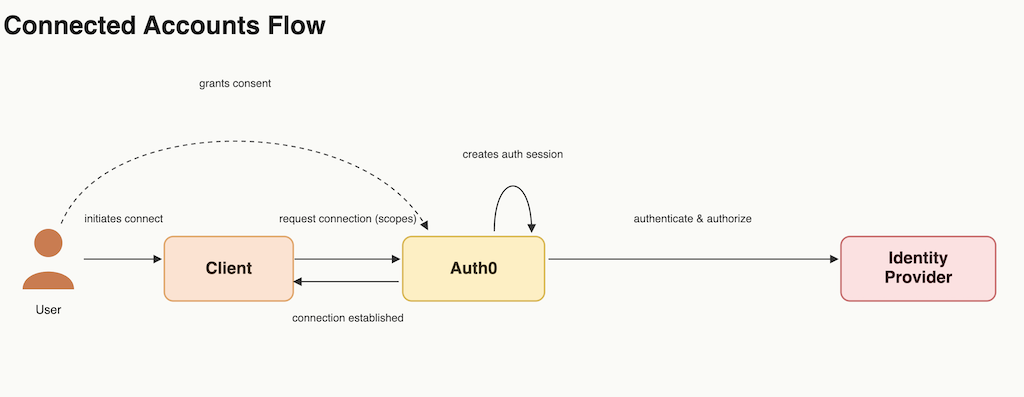
Your AI Agent authenticates to Token Vault with its own strong credential, a Private Key JWT or mTLS certificate, never a shared secret. It presents a signed token asserting who it is, which user it is acting for, and which connection it needs. Auth0 validates that signature, checks the request against a set of guardrails, and hands back a fresh, short-lived access token. No user has to be present, and no raw refresh token ever leaves Auth0's infrastructure.
These guardrails are what make this something your security team can actually sign off on:
- Connection and scope pinning: each worker credential is capped at five connections and 20 scopes. The result: a leaked credential cannot be used to raid the entire vault. An attacker gets only the narrow slice it was issued for, not every user's data.
- Replay protection: every request carries a one-time-use ID, and Auth0 checks that ID has not been used before. If that check cannot run for any reason, the request is blocked rather than let through unverified. Consequently, a captured request cannot be replayed to pull extra tokens beyond what the original call intended.
- IP allowlisting: a worker credential can be restricted to a known set of IP addresses. As a result, even a fully leaked credential is useless to an attacker running from their own infrastructure.
- Required audit context: every request must state its business purpose, logged for traceability. As a result, you get a defensible, per-access answer to ‘why did this agent touch this data.
- Dedicated audit logging: Privileged Worker activity shows up distinctly in your tenant logs, including which worker acted, on whose behalf, and why any request failed. As a result, your security team can investigate an incident in minutes instead of digging through undifferentiated application traffic.
Together, these mean a compromised worker credential has a small, bounded blast radius instead of unrestricted access to every user's data, which is the entire point.
Demo walkthrough of Token Vault Privileged Worker:
The Bottom Line
AI agents that act without a user in the loop are quickly becoming the norm, not the exception, and an identity model built around ‘a human is signed in’ was never going to hold up to that shift. Token Vault Privileged Worker closes that gap as it lets you run background agents against real user data, without building your own sensitive credential store. The result is fewer months spent on custom token-storage infrastructure, and a pattern your CISO can actually sign off on.
Token Vault Privileged Worker is now available in Early Access. To participate, contact Auth0 Support or your Technical Account Manager.